

Table of Contents
You know that 3 PM crash that hits like a brick wall? The one where your brain feels wrapped in cotton and your body moves like it’s underwater?
That’s not just stress. That’s not just getting older.
That’s your cellular power plants shutting down.
And here’s what nobody tells you: every single thing you care about – your focus at work, your energy for your family, your performance in the bedroom, your ability to push through a workout – all of it depends on tiny factories inside your cells called mitochondria.
When they’re struggling, you’re struggling. When they’re thriving, you feel unstoppable.
The question isn’t whether you need to address this. The question is whether you’ll choose the supplements that actually work or waste money on the ones that don’t.
Why Your Energy Crisis Isn’t Just About Sleep
Let me guess – you’ve tried everything. More coffee. Better sleep hygiene. Maybe even those expensive “natural energy” drinks.
Still hitting that wall?
Here’s what’s really happening: Your mitochondria are like the engines in your car. Over time, they accumulate damage. They slow down. They stop producing the cellular energy (ATP) your body needs to function at peak performance.
The Real Problem: Your Cellular Power Plants Are Struggling
Think of it this way: You have trillions of these microscopic power plants in your body. Each one is working 24/7 to keep you alive and performing.
But here’s the brutal truth – after age 35, you start losing mitochondrial function at about 1-2% per year. That might not sound like much, but it compounds.
By 50? You could be operating at 70% of your peak cellular energy capacity.
How This Impacts Everything You Care About
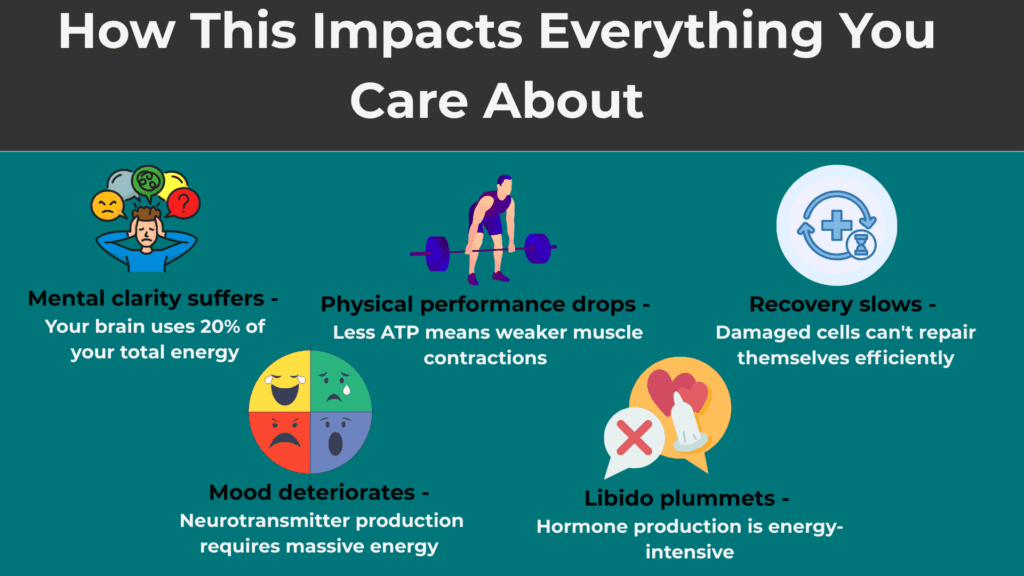
When your cellular energy tanks, everything else follows:
- Mental clarity suffers – Your brain uses 20% of your total energy
- Physical performance drops – Less ATP means weaker muscle contractions
- Recovery slows – Damaged cells can’t repair themselves efficiently
- Mood deteriorates – Neurotransmitter production requires massive energy
- Libido plummets – Hormone production is energy-intensive
The reality is this: You’re not just tired. You’re running on fumes at the cellular level.
Cellular Energy 101: What’s Actually Happening Inside
Before we dive into what actually works, you need to understand the basics. Not because I want to bore you with science, but because understanding this will save you hundreds of dollars on useless supplements.
Your Mitochondria Are Your Body’s Batteries
Every cell in your body contains anywhere from dozens to thousands of mitochondria. These organelles take the food you eat and the oxygen you breathe and convert them into ATP – the universal energy currency your body uses.
Think of ATP like cash. Everything your body does requires this cellular currency. Thinking, moving, breathing, recovering, even maintaining your body temperature.
When mitochondria are healthy and abundant, you have plenty of cash to spend. When they’re damaged or depleted, you’re broke at the cellular level.
Why They Start Failing After 35
Here’s the thing most people don’t realize: mitochondria have their own DNA, separate from your regular DNA. And this mitochondrial DNA is way more vulnerable to damage.
Every day, your mitochondria face:
- Oxidative stress from normal metabolism
- Environmental toxins that accumulate over time
- Inflammatory damage from poor diet and lifestyle
- Natural aging that reduces repair mechanisms
The result? Your cellular power plants start shutting down one by one.
But here’s what’s really happening: Your body has backup systems. It can compensate for a while. That’s why the decline feels gradual at first, then suddenly hits like a wall.
The Supplements That Actually Move the Needle
Let me be crystal clear: Most “energy supplements” are garbage. They’re either stimulants that mask the problem or overpriced blends with ineffective doses.
But there are a few compounds that actually support mitochondrial function at the cellular level. These aren’t magic bullets, but they’re the real deal.
CoQ10: The Cellular Spark Plug
Coenzyme Q10 is like the spark plug in your cellular engine. Without it, your mitochondria can’t produce ATP efficiently.
Here’s the problem: Your body makes less CoQ10 as you age. By 40, your levels have dropped significantly.
The benefits are real:
- Improved cellular energy production – Directly supports ATP synthesis
- Reduced oxidative damage – Protects mitochondria from free radicals
- Better exercise performance – More efficient energy utilization
- Enhanced recovery – Faster cellular repair processes
Ubiquinol vs Ubiquinone: Which Form Works Better
Here’s where most people get confused. There are two forms of CoQ10:
Ubiquinone – The oxidized form. Cheaper but harder for your body to use.
Ubiquinol – The reduced, active form. More expensive but readily absorbed.
The reality? If you’re over 40, go with ubiquinol. Your body’s ability to convert ubiquinone to the active form decreases with age.
Effective dose: 100-200mg daily with fat-containing meals.
PQQ: The Mitochondrial Repair Crew
Pyrroloquinoline quinone sounds complicated, but think of it as your cellular repair crew.
While CoQ10 helps existing mitochondria work better, PQQ actually stimulates the growth of new mitochondria.
This is huge. You’re not just optimizing what you have – you’re building new power plants.
What PQQ does:
- Triggers mitochondrial biogenesis – Literally creates new mitochondria
- Protects against cellular damage – Powerful antioxidant properties
- Improves cognitive function – More brain energy means better thinking
- Enhances sleep quality – Better cellular repair during rest
Effective dose: 10-20mg daily, ideally with CoQ10 for synergistic effects.
NAD+ Precursors: Cellular Communication Boosters
NAD+ (nicotinamide adenine dinucleotide) is like the communication system in your cells. It’s essential for mitochondrial function, DNA repair, and cellular energy production.
The problem: NAD+ levels decline dramatically with age – by up to 50% between ages 40 and 60.
NMN vs NR: The Real Difference
Two main NAD+ precursors dominate the market:
NMN (Nicotinamide Mononucleotide):
- More direct pathway to NAD+
- Better stability and absorption
- Higher cost but potentially more effective
NR (Nicotinamide Riboside):
- Requires more conversion steps
- More research available
- Generally less expensive
Bottom line: Both work, but NMN might have a slight edge for bioavailability.
Effective dose: NMN: 250-500mg daily; NR: 300-600mg daily.
Creatine: Not Just for Gym Bros
Yeah, I know what you’re thinking. “Creatine is for 20-year-old bodybuilders.”
Wrong.
Creatine is one of the most researched supplements for cellular energy – and it works in your brain just as well as your muscles.
Here’s how it works: Creatine helps rapidly regenerate ATP, especially during high-demand situations. Think of it as a backup battery system.
Benefits for men over 35:

- Improved mental clarity – Brain cells need quick energy bursts
- Better physical performance – Not just strength, but endurance too
- Enhanced recovery – Faster ATP regeneration between activities
- Neuroprotective effects – May protect against age-related cognitive decline
Effective dose: 3-5g daily. No loading phase needed at this age.
The Overhyped Supplements Draining Your Wallet
Let’s talk about the supplements that sound amazing but deliver nothing. Because every dollar you waste on garbage is a dollar not spent on what actually works.
Generic “Energy Blends” That Do Nothing
Walk into any supplement store and you’ll see dozens of “energy blends” with flashy names and ingredient lists longer than your grocery receipt.
Here’s the reality: Most contain:
- Caffeine dressed up with fancy names – “Natural energy matrix” = coffee
- B-vitamins in ridiculous doses – Your body just pisses out the excess
- Proprietary blends with undisclosed amounts – Usually ineffective doses
- Fillers and artificial ingredients – Sometimes more filler than active compounds
The truth about B-vitamins: Unless you’re deficient, more won’t give you more energy. It’s like putting premium gas in a car that runs fine on regular.
Expensive Mitochondrial Cocktails with Zero Evidence
Some companies charge $100+ for “advanced mitochondrial support” formulas.
Red flags to watch for:
- Proprietary blends – They won’t tell you doses because they’re too low
- 20+ ingredients – Shotgun approach usually means nothing works well
- Outrageous health claims – “Reverses aging at the cellular level”
- MLM marketing – If your neighbor is selling it, run
Reality check: The compounds that work for mitochondrial health are well-established. You don’t need exotic berries from remote mountains.
Why Most B-Complex Formulas Miss the Mark
B-vitamins are crucial for energy metabolism, but here’s what supplement companies don’t tell you:
Most people aren’t B-vitamin deficient. And if you are, it’s usually due to absorption issues, not intake.
Common problems with B-complex supplements:
- Synthetic forms that aren’t well-absorbed
- Massive doses that overwhelm your system
- Poor ratios that can create imbalances
- Missing cofactors needed for proper utilization
Better approach: Get blood work to check your actual B-vitamin status before supplementing.
How to Actually Use These Supplements
Having the right supplements is only half the battle. Timing, dosing, and combinations matter more than most people realize.
Timing That Matters
Morning (with breakfast):
- CoQ10/Ubiquinol – Needs fat for absorption
- PQQ – Can be energizing for some people
- Creatine – Consistent daily timing matters more than specific timing
Evening (or whenever):
- NAD+ precursors – Some people find them energizing, others don’t
- Avoid high-dose B-vitamins late in the day
With or without food:
- With fat: CoQ10, PQQ
- Empty stomach: NAD+ precursors (better absorption)
- Doesn’t matter: Creatine
Dosing for Real Results
Here’s the thing about supplement dosing: More isn’t always better, but too little is useless.
Start conservatively:
- Week 1-2: Half the recommended dose to assess tolerance
- Week 3-4: Full dose if no issues
- Evaluate at 6-8 weeks: Real mitochondrial improvements take time
Cycling considerations:
- CoQ10: Continuous use is fine
- PQQ: Some people cycle 5 days on, 2 days off
- NAD+ precursors: Continuous use appears safe
- Creatine: No need to cycle
What to Stack (And What Not To)
Synergistic combinations:
- CoQ10 + PQQ – Optimization + new mitochondria creation
- NAD+ precursor + CoQ10 – Communication + energy production
- Creatine + everything – Works well with other compounds
Avoid stacking:
- Multiple NAD+ precursors – Pick one, stick with it
- High-dose antioxidants with exercise – Can blunt training adaptations
- Everything at once – Start with one, add others gradually
Beyond Supplements: The Foundation Work
Here’s a hard truth: Supplements can’t fix a broken foundation.
If you’re sleeping 4 hours a night, eating garbage, and never moving, no supplement will save you. But if you’ve got the basics covered, these compounds can take you to the next level.
The Sleep-Energy Connection You Can’t Ignore
Your mitochondria literally repair themselves during deep sleep. Skip sleep, and you’re undermining everything else you’re doing.
Non-negotiables:
- 7-9 hours of actual sleep – Not time in bed, actual sleep
- Cool, dark room – Mitochondria are sensitive to light and heat
- Consistent schedule – Your cellular clocks depend on routine
- No screens 1 hour before bed – Blue light disrupts mitochondrial function
Exercise Types That Build Cellular Resilience
Not all exercise is created equal when it comes to mitochondrial health.
Best types for mitochondrial biogenesis:
- High-intensity intervals – Brief, intense efforts
- Zone 2 cardio – Moderate intensity you can maintain for 30+ minutes
- Resistance training – Builds mitochondria in muscle tissue
- Cold exposure – Brief cold showers or ice baths
The key: Stress your system enough to trigger adaptation, but not so much that you can’t recover.
Frequently Asked Questions About Cellular Energy Supplements
Q: How long does it take to feel results from mitochondrial supplements?
Most people notice subtle improvements in 2-4 weeks, with more significant changes at 6-8 weeks. Remember: You’re rebuilding cellular infrastructure, not just masking symptoms with stimulants.
Q: Can I take all these supplements together safely?
Generally yes, but start with one at a time. The compounds I’ve mentioned have excellent safety profiles and work through different mechanisms. However: Always consult your doctor if you’re on medications or have health conditions.
Q: Are expensive “mitochondrial cocktails” worth the money?
Usually no. You’re paying for marketing, not efficacy. The individual compounds that work are well-established. You’ll often get better results and save money buying them separately.
Q: Do I need blood work before starting these supplements?
Not required, but smart. Basic markers to check:
CoQ10 levels
B-vitamin status
Inflammatory markers (CRP)
Basic metabolic panel
Q: What’s the difference between feeling energetic and having cellular energy?
Feeling energetic often comes from stimulants – it’s temporary and followed by a crash.
Having cellular energy means your mitochondria are functioning optimally. You feel sustainably energetic without the ups and downs.
Q: Can diet alone improve mitochondrial function without supplements?
Absolutely. Mitochondria-supporting foods include:
Fatty fish (CoQ10)
Organ meats (B-vitamins, CoQ10)
Dark leafy greens (folate, magnesium)
Berries (antioxidants)
But here’s the reality: Getting therapeutic doses of compounds like PQQ or NAD+ precursors from food alone is nearly impossible.
The Bottom Line
Your energy isn’t just fading because you’re getting older. It’s fading because your cellular power plants need support.
The supplements that actually work aren’t the flashy ones with 20 ingredients and outrageous claims. They’re the boring, well-researched compounds that directly support mitochondrial function.
Your next steps:
- Start with one supplement – Don’t overwhelm your system
- Give it 6-8 weeks – Real cellular changes take time
- Track your energy levels – Use a simple 1-10 scale daily
- Address the foundation – Sleep, nutrition, and movement matter more than any pill
Here’s what I want you to remember: You don’t have to accept declining energy as inevitable. Your mitochondria can be rebuilt, optimized, and protected.
The question is: Will you choose the supplements that actually work, or keep throwing money at solutions that don’t?
If this resonated with you and you’re ready to take your cellular energy seriously, start with CoQ10 or ubiquinol. It’s the most researched, most reliable option for mitochondrial support.
Your future self – the one with sustained energy, mental clarity, and peak performance – will thank you.
Disclaimer: This content is for informational purposes only and is not a substitute for professional medical advice, diagnosis, or treatment. Always seek the advice of your physician or other qualified health provider with any questions you may have regarding a medical condition.
Read More on Topics ENERGY & PERFORMANCE


