Table of Contents
Ever feel like your mind is swimming in syrup? It always happens at the worst times too.
Or when you reach for your third cup of coffee by noon, knowing full well you’re setting yourself up for an afternoon crash that’ll leave you feeling worse than when you started?
Here’s the brutal truth: Most men are using caffeine completely wrong.
You’re not broken. Your willpower isn’t weak. You’re just trapped in a cycle that’s working against your biology instead of with it.
Every day, millions of high-performing men sabotage their own focus and energy because nobody taught them how caffeine actually works. The result? You feel dependent, jittery, and constantly chasing the next fix.
But what if there was a better way?
Why Your Current Caffeine Strategy Is Working Against You
Think about your last truly productive day. I’m willing to bet it wasn’t the day you downed five cups of coffee and felt wired but unfocused.
The problem isn’t caffeine itself – it’s how you’re using it.
Most men treat coffee like a hammer when they need a scalpel. More isn’t better. Random timing isn’t strategic. And ignoring your body’s natural rhythms is like trying to swim upstream.
The Hidden Cost of Caffeine Chaos
Here’s what’s really happening when you wing your caffeine intake:
- Your cortisol levels spike at the worst times – adding stress when you’re already stressed
- You build tolerance faster – needing more to feel normal, not even energized
- Your sleep quality tanks – even if you fall asleep, you’re not getting restorative rest
- You create energy debt – borrowing from tomorrow’s energy to fuel today
- Your mood becomes unpredictable – irritable, anxious, or flat without your fix
The hidden cost? You start questioning your own capabilities. When focus becomes unreliable, confidence follows.
What Most Men Get Wrong About Coffee Timing
“I need my coffee first thing in the morning.”
Sound familiar? Here’s the thing – studies say your body is already producing peak cortisol when you wake up. Adding caffeine on top is like pouring gasoline on a fire that’s already burning bright.
You’re wasting your body’s natural energy boost and setting yourself up for a harder crash later.
The Science Behind Smart Caffeine Use
Let’s get real about what’s actually happening in your brain when you drink coffee.
How Caffeine Actually Works in Your Brain
Caffeine doesn’t create energy – it blocks the signals that tell you you’re tired.
Think of it like this: Your brain has a “tiredness meter” called adenosine. Throughout the day, adenosine builds up, making you feel more tired. Caffeine is like putting tape over that meter – you can’t see the reading, but the tiredness is still accumulating underneath.
This is why the crash happens. When caffeine wears off, all that accumulated tiredness hits you at once.
Why Timing Beats Dosage Every Time
Most guys focus on how much coffee they’re drinking. Smart guys focus on when.
Your body has natural energy peaks and valleys throughout the day. The goal isn’t to override these rhythms – it’s to enhance them strategically.
Here’s the game-changer: When you time caffeine right, you need less to achieve more.
The Smart Caffeine Protocol: Your Step-by-Step System
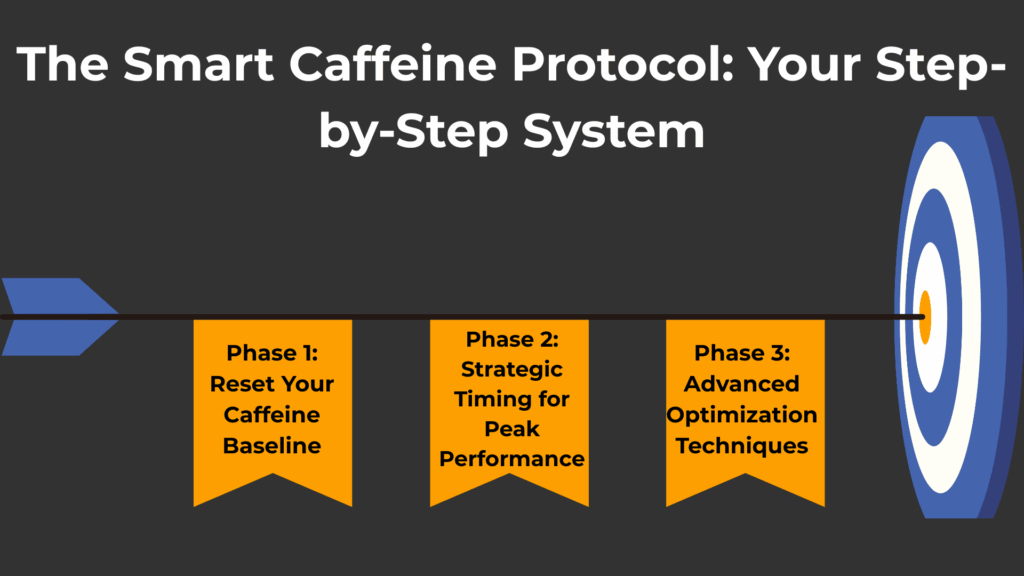
Forget everything you think you know about coffee. This isn’t about restriction – it’s about optimization.
Phase 1: Reset Your Caffeine Baseline
Before you can optimize, you need to know your starting point.
Week 1-2: The Reset
- Cut caffeine by 50% immediately (don’t go cold turkey unless you hate yourself)
- Track your energy levels every 2 hours for one week
- Note when you naturally feel alert vs. when you crash
- Identify your actual energy patterns without caffeine interference
What to expect: You’ll feel rough for 2-3 days. Push through. Your natural energy will stabilize by day 4.
Phase 2: Strategic Timing for Peak Performance
Now for the real strategy. This is where most men see dramatic improvements in focus and sustained energy.
The Smart Timing Formula:
- 90-120 minutes after waking: Your first (and possibly only) dose
- 200-400mg total daily max: Less than you think you need
- 8-10 hours before bed: Hard cutoff time
- 30-45 minutes before important tasks: Strategic performance boost
Why this works: You’re enhancing natural cortisol dips, not competing with peaks.
Phase 3: Advanced Optimization Techniques
Once you’ve mastered basic timing, these advanced strategies separate the pros from the amateurs:
The Performance Stack:
- L-theanine + caffeine: Smooth energy without jitters (100mg theanine per 200mg caffeine)
- Hydration first: 16-20oz water before any caffeine
- Food buffer: Never on an empty stomach
- Movement activation: 5-10 minutes of light movement post-caffeine
Pro tip: The most successful guys I know use caffeine like a precision tool, not a crutch.
Avoiding the Three Biggest Caffeine Mistakes

Let’s talk about the mistakes that keep you stuck in the energy rollercoaster.
Mistake #1: The Morning Rush Trap
You wake up, feel groggy, and immediately reach for coffee.
The problem: You’re training your body to depend on external stimulation instead of its natural wake-up process.
The fix: Wait 90-120 minutes after waking. Use that time for hydration, light, and movement. Your natural cortisol will do most of the heavy lifting.
Mistake #2: Fighting Afternoon Fatigue with More Coffee
That 2 PM energy crash hits, and your first instinct is another cup of coffee.
But here’s what’s really happening: You’re not tired because you need more caffeine. You’re tired because you’re human, and your circadian rhythm naturally dips in the afternoon.
The better approach:
- 10-20 minute power nap (if possible)
- 5-10 minutes of movement or fresh air
- Hydration and a protein-rich snack
- If you must use caffeine, make it your last dose of the day
Mistake #3: Ignoring Your Sleep Window
“I can drink coffee at 4 PM and sleep fine.”
No, you can’t. You might fall asleep, but caffeine has a 6-8 hour half-life. Even if you don’t feel “wired,” it’s interfering with deep sleep quality.
The reality check: Poor sleep creates tomorrow’s energy problem, making you more dependent on caffeine. It’s a vicious cycle.
When to Take a Caffeine Break (And How to Do It Right)
Sometimes the best strategy is hitting the reset button completely.
Signs you need a caffeine detox:
- You need coffee just to feel normal (not energized)
- You’re drinking more than 400mg daily (about 4 cups)
- Sleep quality has declined noticeably
- You feel anxious or jittery regularly
- Coffee has stopped providing any noticeable benefit
The Smart Detox Protocol:
- Days 1-3: Expect headaches and fatigue – this is normal
- Days 4-7: Energy starts stabilizing naturally
- Week 2: You’ll feel more consistent energy throughout the day
- Week 3+: Your baseline energy will be higher than before
Pro tip: Schedule your detox during a less demanding period. Don’t try to detox during your biggest work project.
The Bottom Line
Smart caffeine use isn’t about restriction – it’s about precision.
When you align your caffeine intake with your body’s natural rhythms instead of fighting against them, everything changes. You get sustained focus without the jitters. Steady energy without the crash. And most importantly, you regain control over your daily performance.
Your next steps:
- Track your current caffeine intake for one week
- Implement the 90-120 minute morning delay starting tomorrow
- Set a hard caffeine cutoff 8-10 hours before bedtime
- Experiment with the performance stack (L-theanine + caffeine)
- Schedule a reset period if you’re drinking more than 400mg daily
Remember: The goal isn’t to eliminate caffeine – it’s to make it work for you instead of against you.
Your focus, energy, and confidence are too important to leave to chance. When you optimize something as fundamental as your energy system, everything else becomes easier.
If this resonated with you, start with just one change tomorrow. Small adjustments compound into massive improvements over time.
Disclaimer: This content is for informational purposes only and is not a substitute for professional medical advice, diagnosis, or treatment. Always seek the advice of your physician or other qualified health provider with any questions you may have regarding a medical condition.
Read More on Energy & Performance