

Table of Contents
The Stubborn Fat Reality That’s Driving You to Consider Peptides
You’re doing everything right. Eating in a calorie deficit. Hitting the gym consistently. Getting adequate sleep and managing stress.
But that stubborn belly fat isn’t budging. Your body seems determined to hold onto those last 15-20 pounds that stand between you and the physique you had in your thirties.
Here’s what’s really frustrating: You know guys who seem to eat whatever they want and stay lean effortlessly. Meanwhile, you’re meticulously tracking macros and still fighting for every pound of fat loss.
The cruel reality of aging metabolism hits different when you’re staring at yourself in the mirror. That confident, athletic identity you’ve carried for decades starts to feel like it’s slipping away, replaced by someone who looks soft and ordinary.
You’ve probably tried the usual suspects: Fat burners loaded with caffeine that leave you jittery and crashing. Extreme diets that work temporarily but aren’t sustainable. Every new supplement that promises to “rev up your metabolism.”
But here’s what’s driving men like you to research fat loss peptides: The promise of supporting your metabolism at the cellular level instead of just stimulating it with caffeine and hoping for the best.
Fat loss peptides aren’t magic bullets. But they might be a more intelligent approach to working with your body’s natural fat-burning mechanisms instead of fighting against them.
Why Traditional Fat Loss Methods Stop Working (And What That Does to Your Confidence)
Let’s address the elephant in the room: Fat loss gets progressively harder as you age, and it’s not just about willpower or dedication.
When Your Metabolism Stops Cooperating
Your metabolic rate doesn’t just slow down – it becomes less efficient at utilizing the fat you want to lose.
What’s happening to your fat-burning machinery:
Hormonal changes:
- Growth hormone production drops by 50% after age 40 – according to scientific studies.
- Testosterone decline reduces muscle mass – your primary metabolic engine
- Insulin sensitivity decreases – your body stores fat more easily
- Thyroid function often becomes sluggish – slowing overall metabolic rate
Cellular efficiency decline:
- Mitochondrial function deteriorates – your cellular power plants work less efficiently
- Fat oxidation capacity decreases – your body gets worse at actually burning stored fat
- Recovery slows – you can’t train with the same intensity or frequency
- Inflammation increases – chronic low-grade inflammation interferes with fat loss
The compound effect:
- Each year makes fat loss slightly harder – small changes that accumulate over time
- Muscle loss accelerates – less metabolic tissue to burn calories
- Sleep quality often declines – poor sleep disrupts hunger and satiety hormones
- Stress management becomes more challenging – elevated cortisol promotes fat storage
The Identity Crisis of Losing Your Edge
This isn’t just about looking good in a shirt. For many men, losing their physical edge feels like losing part of who they are.
The psychological cascade:
- Professional confidence takes a hit – if you can’t manage your own body, how can you manage everything else?
- Social situations become uncomfortable – avoiding beaches, pools, or situations where you’d remove your shirt
- Relationship dynamics shift – feeling less attractive and confident with your partner
- Health anxiety increases – wondering what other aspects of aging are accelerating
The frustration compounds when:
- You’re doing everything “right” according to conventional advice
- Results come slower and slower despite consistent effort
- Other men your age seem to maintain their physiques more easily
- You start questioning your knowledge and discipline
This is where the appeal of peptides becomes understandable. They represent hope for a different approach when traditional methods feel like you’re fighting an uphill battle.
What Fat Loss Peptides Actually Are (Not Magic, But Not Useless)
Fat loss peptides are small protein fragments that may influence metabolic processes at the cellular level. Think of them as molecular signals that could help optimize your body’s natural fat-burning mechanisms.
How They Work With Your Body, Not Against It

Unlike stimulants that force your metabolism to work faster, peptides potentially work by optimizing the efficiency of existing metabolic pathways.
The theoretical advantages:
Cellular targeting:
- May enhance mitochondrial function – improving your cells’ ability to burn fat for energy
- Could optimize hormone signaling – supporting natural growth hormone and metabolic hormones
- Potentially improve insulin sensitivity – helping your body partition nutrients better
- May reduce inflammation – creating a more favorable environment for fat loss
Sustainable mechanisms:
- Work with natural biological processes rather than overstimulating them
- Don’t create tolerance the way stimulants do
- May provide benefits beyond fat loss – improved recovery, better sleep, enhanced well-being
- Could support long-term metabolic health rather than just short-term weight loss
Why They’re Different from Stimulants and Fat Burners
Traditional fat burners rely on stimulation and often create a cycle of dependence and diminishing returns.
Stimulant-based fat burners:
- Increase heart rate and energy expenditure through activation of the nervous system
- Suppress appetite temporarily through dopamine and norepinephrine manipulation
- Create tolerance – requiring higher doses for the same effect
- Often cause crashes – energy and mood drops when effects wear off
- Can interfere with sleep – disrupting recovery and hormonal balance
Peptide-based approaches:
- May optimize metabolic efficiency at the cellular level
- Work through growth factors and signaling pathways rather than stimulation
- Don’t typically cause tolerance – effects may be sustained with consistent use
- Often improve rather than disrupt sleep – supporting recovery and hormonal balance
- May provide systemic benefits – not just isolated fat loss effects
[Fat Loss Peptides Explained: How They Work in the Body] provides detailed mechanisms and cellular pathways for each major fat loss peptide.
The Big Three: Peptides That Show Real Promise
While many peptides are marketed for fat loss, three have the most research and user reports supporting their potential effectiveness.
AOD9604: The Fragment That Targets Fat Cells
AOD9604 is a fragment of human growth hormone that was specifically modified to retain fat-burning properties while eliminating other growth hormone effects.
How AOD9604 theoretically works:
- Stimulates lipolysis – the breakdown of stored fat in adipose tissue
- Inhibits lipogenesis – reduces the formation of new fat from dietary sources
- May preferentially target abdominal fat – the stubborn visceral fat that’s hardest to lose
- Doesn’t affect blood sugar – unlike full growth hormone, it may not impact glucose metabolism
Research and user reports:
- Limited human studies show modest fat loss in clinical settings
- Animal research demonstrates selective fat-burning effects
- User reports suggest gradual body composition improvements over 12-16 weeks
- Best results typically seen when combined with proper diet and exercise
Realistic expectations:
- Gradual fat loss – typically 1-3 pounds per month with proper lifestyle
- Body composition improvements may be more noticeable than scale weight
- Takes 8-12 weeks to see significant changes
- Not a substitute for caloric deficit and exercise
MOTS-c: The Mitochondrial Optimizer
MOTS-c (Mitochondrial Open Reading Frame of the 12S rRNA-c) is a peptide that may enhance mitochondrial function and metabolic efficiency.
MOTS-c’s proposed mechanisms:
- Improves mitochondrial biogenesis – helps create new, healthy mitochondria
- Enhances fat oxidation – improves your cells’ ability to burn fat for energy
- May increase insulin sensitivity – better glucose utilization and fat partitioning
- Could improve exercise capacity – more efficient energy production during workouts
Potential benefits:
- Enhanced energy levels – from improved cellular energy production
- Better exercise performance – increased capacity for fat-burning during training
- Improved recovery – more efficient cellular repair and adaptation
- Metabolic flexibility – better ability to switch between burning carbs and fat
Current evidence:
- Promising animal studies showing metabolic improvements
- Limited human research – mostly small pilot studies
- Strong theoretical basis – mitochondrial function is crucial for fat loss
- User reports of improved energy and gradual body composition changes
5-Amino 1MQ: The NNMT Inhibitor
5-Amino 1MQ works by inhibiting NNMT (nicotinamide N-methyltransferase), an enzyme that may contribute to fat accumulation and metabolic dysfunction.
How NNMT inhibition may help:
- Increases cellular NAD+ – supporting energy production and fat oxidation
- May reduce fat storage – particularly in white adipose tissue
- Could improve insulin sensitivity – better glucose and lipid metabolism
- Potentially enhances mitochondrial function – through increased NAD+ availability
Theoretical advantages:
- Targets a specific metabolic pathway – more precise than broad-spectrum approaches
- May have anti-aging effects – NAD+ is crucial for cellular health and longevity
- Could improve metabolic flexibility – better fuel utilization across different states
- Potentially sustainable – working through fundamental metabolic processes
Current status:
- Very limited human research – mostly theoretical and animal studies
- Strong mechanistic rationale – NNMT is implicated in metabolic dysfunction
- Early user reports suggest potential benefits but highly variable
- Long-term effects unknown – this is experimental territory
[AOD9604, MOTS-c & 5-Amino 1MQ: Peptides That Support Weight Loss] provides detailed protocols, dosing guidelines, and realistic outcome expectations.
Peptides vs. the Stimulant Trap
Most men have been caught in the stimulant cycle at some point: Increasing doses of caffeine, trying stronger and stronger fat burners, eventually hitting a wall where nothing seems to work anymore.
Why Caffeine and Stimulants Eventually Fail You
Stimulants create a pattern of diminishing returns that actually makes long-term fat loss harder.
The stimulant trap:
- Tolerance builds rapidly – what worked last month stops working this month
- Sleep disruption – poor sleep destroys fat loss hormones and recovery
- Adrenal fatigue – chronic stimulation leads to burnout and metabolic slowdown
- Appetite rebound – when stimulants wear off, hunger comes back with a vengeance
- Energy crashes – the inevitable low that follows every stimulant high
The long-term consequences:
- Metabolic adaptation – your body becomes more efficient at conserving energy
- Hormonal disruption – elevated cortisol, disrupted sleep, reduced testosterone
- Psychological dependence – feeling unable to function or train without stimulants
- Diminished natural energy – your baseline energy levels become lower
The Sustainable Energy and Metabolism Approach
Peptides potentially offer a different path: Supporting your natural metabolic processes instead of forcing them to work harder.
Sustainable fat loss principles:
- Work with biological systems rather than overstimulating them
- Support long-term metabolic health instead of just short-term weight loss
- Enhance rather than replace natural energy production
- Improve recovery and adaptation to support continued progress
How peptides may fit this approach:
- Cellular optimization – improving mitochondrial function and efficiency
- Hormonal support – working with growth factors and metabolic hormones
- Anti-inflammatory effects – creating better conditions for fat loss
- Recovery enhancement – supporting sleep and tissue repair
The mindset shift:
- Patient optimization instead of quick fixes
- Health-first approach rather than results at any cost
- Sustainable practices that you can maintain long-term
- Integrated strategy – peptides as part of comprehensive lifestyle
[Peptides vs. Stimulants: A Smarter Approach to Fat Loss?] compares long-term outcomes and provides transition strategies for moving away from stimulant dependence.
The Right Way to Integrate Peptides (If You’re Going to Use Them)

Here’s the hard truth: If your diet and training aren’t optimized, peptides won’t save you. They’re enhancement tools, not replacement strategies.
Diet and Training Still Come First
Peptides work best when they have a solid foundation to build on.
Non-negotiable fundamentals:
Nutrition foundation:
- Consistent caloric deficit – you still need to consume fewer calories than you burn
- Adequate protein – 1.2-1.6g per kg body weight for muscle preservation
- Micronutrient density – vitamins and minerals support metabolic processes
- Meal timing – consistent eating patterns support hormonal rhythms
- Hydration – proper fluid balance affects every metabolic process
Training requirements:
- Progressive resistance training – maintaining and building muscle mass
- Cardiovascular exercise – improving heart health and fat oxidation capacity
- Recovery protocols – adequate rest between sessions for adaptation
- Movement variety – different stimuli to prevent adaptation and plateaus
Lifestyle optimization:
- Sleep quality – 7-9 hours of restorative sleep for hormonal balance
- Stress management – chronic stress sabotages fat loss regardless of other efforts
- Consistent routine – regular patterns support metabolic rhythms
- Patience and persistence – sustainable fat loss takes time
Realistic Timelines and Expectations
Managing expectations is crucial for success with any fat loss approach, especially with peptides.
Realistic peptide fat loss timeline:
Week 1-4: Foundation phase
- Little to no visible changes – peptides work at the cellular level first
- Possible energy improvements – better workout quality and recovery
- Sleep and mood benefits – indirect support for fat loss efforts
- Gradual appetite regulation – subtle changes in hunger and satiety
Week 6-12: Development phase
- Modest body composition changes – gradual fat loss and possible muscle preservation
- Improved training capacity – better performance and recovery
- Enhanced metabolic flexibility – easier to maintain deficit
- 1-3 pounds of fat loss – realistic monthly rate with proper diet and training
Week 12-24: Optimization phase
- Continued gradual progress – sustainable fat loss rate
- Body composition improvements become more noticeable
- Metabolic benefits may persist beyond active treatment
- Total progress varies widely – individual responses differ significantly
Important reality checks:
- Individual variation is enormous – some people respond well, others minimally
- Lifestyle factors matter more than peptide choice or dosing
- Patience is required – dramatic transformations take months, not weeks
- Maintenance planning is crucial for keeping results long-term
[How to Combine Peptides with Diet & Training for Best Results] provides complete integration protocols and optimization strategies.
What Can Go Wrong (And How to Avoid It)
The fat loss peptide space has significant quality, legal, and safety concerns that most promotional content glosses over.
The Side Effects Nobody Talks About
While generally considered safer than stimulants, studies show that fat loss peptides can still cause problems.
Common side effects:
- Injection site reactions – redness, swelling, or irritation
- Mild nausea – especially when starting or with higher doses
- Headaches – particularly during initial weeks
- Sleep disturbances – some peptides may affect sleep patterns
- Mood changes – irritability or emotional sensitivity
More concerning possibilities:
- Blood sugar effects – some peptides may impact glucose metabolism
- Hormonal disruption – interference with natural hormone production
- Immune system effects – peptides can affect immune function
- Long-term unknowns – limited safety data for extended use
Red flags requiring medical attention:
- Severe allergic reactions – difficulty breathing, widespread rash
- Significant mood changes – depression, anxiety, or emotional instability
- Persistent side effects – problems that don’t resolve after 1-2 weeks
- Unusual symptoms – anything that seems abnormal or concerning
Quality and Legal Considerations
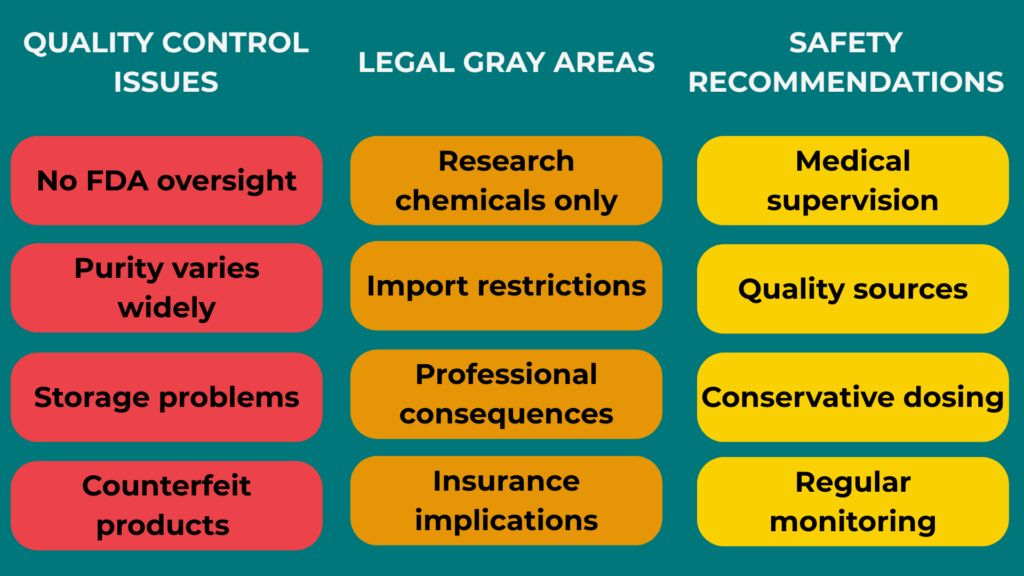
The regulatory landscape for fat loss peptides is complex and problematic.
Quality control issues:
- No FDA oversight – research chemicals have no quality standards
- Purity varies widely – unknown contaminants or incorrect concentrations
- Storage problems – peptides are fragile and degrade easily
- Counterfeit products – fake or mislabeled compounds are common
Legal gray areas:
- Research chemicals only – not approved for human consumption
- Import restrictions – may face customs issues
- Professional consequences – some employers prohibit use
- Insurance implications – no coverage for adverse effects
Safety recommendations:
- Medical supervision – work with knowledgeable healthcare providers
- Quality sources – pharmaceutical-grade compounds when available
- Conservative dosing – start low and adjust based on response
- Regular monitoring – blood work and health assessments
[What to Watch Out for with Fat-Burning Peptides] provides comprehensive safety protocols and risk management strategies.
Are You Actually a Good Candidate for Fat Loss Peptides?
Not everyone should consider fat loss peptides, and honest self-assessment is important before exploring this option.
When Peptides Make Sense
Consider peptides only if:
- You’ve consistently followed proper diet and training for at least 6 months
- You’ve optimized sleep, stress, and other lifestyle factors
- You have specific body composition goals rather than just wanting to lose weight
- You understand the experimental nature and accept unknown risks
- You can afford proper medical supervision and quality compounds
- You’re looking for optimization rather than transformation
Ideal candidate characteristics:
- Already relatively lean – trying to lose the last 10-20 pounds
- Experienced with diet and training – understand fundamentals thoroughly
- Patient and realistic – willing to commit to months of consistent use
- Health-conscious – prioritize well-being over rapid results
- Financially stable – can afford ongoing costs without stress
When You Should Focus on Fundamentals Instead
Avoid peptides if:
- You haven’t mastered basic nutrition – inconsistent eating patterns or extreme approaches
- Your training is sporadic – irregular exercise or poor program adherence
- You’re looking for quick fixes – wanting dramatic results in weeks
- You have significant weight to lose – more than 30-40 pounds
- You can’t afford medical oversight – planning to self-experiment unsupervised
Focus on fundamentals if:
- You’re just starting your fat loss journey – basics will give you 80% of results
- You have underlying health issues – medical problems need addressing first
- Your lifestyle is chaotic – inconsistent sleep, high stress, poor time management
- You’re emotionally eating – psychological relationship with food needs work
- Budget is tight – fundamentals are free or low-cost
Building Sustainable Fat Loss Without Relying on Compounds
The most successful long-term fat loss happens through systematic lifestyle optimization, not compound dependence.
The Metabolic Health Foundation
True fat loss success comes from building a robust metabolic foundation that works independently of any external compounds.
Core metabolic health principles:
Sleep optimization:
- 7-9 hours of consistent sleep – when fat loss hormones are produced
- Dark, cool sleeping environment – supports deep sleep and recovery
- Consistent sleep schedule – maintains circadian rhythm and hormonal patterns
- Screen curfew – blue light disrupts melatonin and sleep quality
Stress management:
- Regular stress reduction practices – meditation, yoga, nature time
- Work-life boundaries – preventing chronic stress from disrupting metabolism
- Social connection – relationships and community support overall health
- Enjoyable physical activity – exercise should enhance, not add stress
Nutritional consistency:
- Sustainable caloric deficit – moderate rather than extreme restrictions
- Food quality focus – whole foods that support metabolic health
- Flexible approach – allowing for social eating and food enjoyment
- Long-term perspective – habits that can be maintained for years
Long-Term Body Composition Strategies
Building the body you want requires thinking in years, not months.
Sustainable strategies:
- Slow, steady fat loss – 1-2 pounds per month maintains muscle and metabolism
- Strength training consistency – muscle preservation and metabolic support
- Metabolic flexibility – ability to use both carbs and fat for fuel
- Habit-based approach – focusing on behaviors rather than just outcomes
Psychological health:
- Positive body image – self-acceptance while working toward goals
- Intrinsic motivation – health and vitality over appearance alone
- Flexible mindset – ability to adapt when life circumstances change
- Support systems – family, friends, or professionals who understand your goals
The compound effect:
- Small improvements accumulate over months and years
- Habits become automatic – less willpower required over time
- Health improvements extend far beyond body composition
- Sustainable results that don’t require constant vigilance or intervention
Frequently Asked Questions About Fat Loss Peptides
How much weight can you lose with fat loss peptides?
Realistic expectations are 1-3 pounds of fat loss per month when combined with proper diet and exercise. Individual results vary dramatically based on starting body composition, lifestyle factors, and genetic response.
Factors affecting results:
Starting body fat percentage – leaner individuals may see slower progress
Diet and training consistency – fundamentals still determine most results
Individual response – some people are high responders, others see minimal benefits
Duration of use – longer protocols generally show better outcomes
Important reality check: Peptides are optimization tools, not transformation methods. Dramatic weight loss requires addressing lifestyle fundamentals first.
Are fat loss peptides safe for long-term use?
Long-term safety data is largely unknown since most research has been short-term and in specific populations.
Short-term safety considerations:
Generally well-tolerated in healthy adults based on available studies
Side effects are typically mild – injection site reactions, mild nausea
Individual sensitivity varies – some people may be more susceptible to problems
Long-term unknowns:
No studies beyond 6-12 months of continuous use
Unknown effects on hormone production with extended use
Potential for tolerance or adaptation not well studied
Interaction effects with aging and other health changes
Best practice: Use under medical supervision with regular monitoring and periodic breaks from treatment.
Do you need a prescription for weight loss peptides?
Legal access varies by location and specific peptide. Most fat loss peptides exist in regulatory gray areas.
Current regulatory status:
Not FDA approved for weight loss or human use
Research chemicals – sold for research purposes, not human consumption
Compounding pharmacy access – some peptides available with prescription in certain states
Import restrictions – may face customs issues when ordering internationally
Legitimate access paths:
Anti-aging or wellness clinics – some prescribe peptides off-label
Compounding pharmacies – with proper prescription and medical oversight
Research institutions – for legitimate research purposes only
Important: Avoid online research chemical companies for human use – quality and safety are not guaranteed.
Can fat loss peptides replace diet and exercise?
Absolutely not. Fat loss peptides may enhance the results of proper diet and exercise but cannot replace these fundamental requirements.
Why fundamentals still matter:
Caloric deficit is required – you must burn more calories than you consume
Muscle preservation – resistance training prevents muscle loss during fat loss
Metabolic health – proper nutrition supports all cellular processes
Habit formation – sustainable results require sustainable behaviors
Peptides as enhancement tools:
May improve workout quality – better energy and recovery
Could enhance fat oxidation – more efficient use of stored fat for energy
Might reduce muscle loss – better protein synthesis during caloric deficit
May improve adherence – feeling better makes it easier to stick to programs
How long does it take to see results from fat loss peptides?
Initial changes may appear within 2-4 weeks, but significant body composition improvements typically take 2-4 months of consistent use.
Realistic timeline:
Week 1-2: Possible improvements in energy, sleep, or recovery
Week 4-8: Initial body composition changes may become noticeable
Week 8-16: Significant changes in fat loss and muscle definition
Beyond 4 months: Continued gradual improvements with diminishing returns
Factors affecting timeline:
Starting body composition – leaner individuals may see changes more slowly
Diet and exercise consistency – fundamentals accelerate peptide effects
Individual response – genetic factors influence how quickly you respond
Dosing and protocol – higher doses or combination protocols may work faster
Your Body Composition Journey Is Marathon, Not a Sprint
Let’s cut through the noise and get to what really matters for your long-term success.
You didn’t gain that stubborn fat overnight, and you’re not going to lose it overnight either – regardless of what compounds you use. The men who successfully transform their physiques and keep the results aren’t the ones looking for shortcuts. They’re the ones who build sustainable systems.
Fat loss peptides can be valuable tools, but only when they’re part of a comprehensive approach that prioritizes health, sustainability, and realistic expectations. They’re not magic bullets, they’re not substitutes for fundamentals, and they’re definitely not the most important factor in your success.
The harsh reality: Most men who struggle with body composition aren’t failing because they lack access to peptides or other compounds. They’re failing because they haven’t built consistent habits around the basics that matter most.
But here’s the encouraging truth: When you do optimize sleep, nutrition, training, and stress management, the results are often better than anything you can achieve through compounds alone. And if you choose to add peptides as an enhancement tool, they’re likely to be much more effective on that solid foundation.
Your next steps:
- Audit your fundamentals honestly – are you truly consistent with sleep, nutrition, and training?
- Set realistic body composition goals – focus on health and sustainability over dramatic transformation
- Find qualified medical guidance – if considering peptides, work with knowledgeable healthcare providers
- Invest in education – understand the science behind effective fat loss approaches
- Build patience and persistence – successful body composition changes take months to years
- Focus on health first – body composition improvements should enhance, not compromise, your well-being
The reality is this: Your body wants to be healthy and function optimally. Age-related metabolic slowdown is real, but it’s not insurmountable with the right approach.
If this resonated with you and you’re ready to approach fat loss strategically, start with a honest assessment of your current habits and build from there. Whether you ultimately choose to include peptides or not, success will come from consistency with proven strategies, not from any single compound or technique.
The lean, healthy version of yourself is achievable. But he requires systematic support through sustainable lifestyle practices, not quick fixes that promise more than they can deliver.
Disclaimer: This content is for informational purposes only and is not a substitute for professional medical advice, diagnosis, or treatment. Always seek the advice of your physician or other qualified health provider with any questions you may have regarding a medical condition.
Read More on Topics Metabolic & Fat Loss Peptides, Peptides & Performance Compounds.


