

Table of Contents
You know that feeling when the sex is technically “good”—everything works, you both finish—but something’s missing?
Like you went through the motions but never really connected. Like you were performing rather than experiencing. Like you could have been with anyone.
Here’s the uncomfortable truth most men don’t want to face: Physical performance doesn’t equal sexual satisfaction. Not for you, and definitely not for your partner.
You can have perfect technique, amazing stamina, and still feel empty afterward. Still feel like something fundamental is missing from your intimate life.
Why? Because great sex isn’t just physical. It’s emotional, psychological, and deeply connected to how safe and understood you feel with your partner.
But here’s what nobody talks about: Most men are terrible at emotional intimacy. We’ve been conditioned to see vulnerability as weakness, emotions as feminine, and deep connection as something that might compromise our masculine identity.
The result? We settle for sex that’s technically functional but emotionally hollow. We wonder why the passion fades, why our partners seem less interested, why we feel disconnected even during intimate moments.
The stakes here are higher than you think. When emotional connection is missing, physical pleasure becomes shallow and unsustainable. Relationships suffer. Desire fades. What should be one of life’s greatest pleasures becomes just another task to perform.
But when you understand how emotional health shapes physical pleasure—and learn to build real intimacy—everything changes.
When Great Sex Feels Empty (And You Don’t Know Why)
Most men measure sexual success by physical metrics. Did it happen? Did everyone finish? Was the performance solid?
But those metrics miss the most important part of sexual satisfaction.
The Performance vs. Satisfaction Disconnect
You might have “successful” sex that leaves you feeling:
- Technically accomplished but emotionally disconnected
- Like you performed well but didn’t really enjoy it
- Satisfied physically but empty emotionally
- Closer to orgasm than to your partner
- Like you’re going through the motions rather than experiencing pleasure
Sound familiar?
Research on sexual satisfaction vs. sexual performance in men indicates that men who focus solely on physical performance report lower overall sexual satisfaction and relationship quality.
Here’s what’s really happening: You’re optimizing for the wrong metrics.
Why Physical Success Can Feel Like Emotional Failure
The performance trap looks like this:
- You focus on technique instead of connection
- You worry about how you’re doing instead of what you’re feeling
- You try to please your partner without really knowing them
- You measure success by physical outcomes rather than emotional intimacy
- You avoid vulnerability because it might affect performance
The result: Sex becomes a performance you give rather than an experience you share.
Signs you’re caught in the performance trap:
- You feel relieved when sex is “over” rather than satisfied
- You avoid eye contact during intimate moments
- You focus more on your partner’s response than your own experience
- You feel pressure to perform rather than desire to connect
- You rarely talk about what you actually want or feel
The cruel irony? The more you focus on performance, the less satisfying sex becomes for everyone involved.
The Truth About What Actually Drives Sexual Satisfaction
Forget everything you think you know about what makes sex great.
Research consistently shows that emotional connection is the strongest predictor of sexual satisfaction—stronger than technique, frequency, or physical performance.
Beyond Performance: What Research Really Shows
Longitudinal study on factors predicting sexual satisfaction in couples found that emotional intimacy was the single strongest predictor of long-term sexual satisfaction, accounting for more variance than all physical factors combined.
What actually drives sexual satisfaction:
- Emotional safety – Feeling accepted and understood by your partner
- Present-moment connection – Being fully engaged rather than performing
- Authentic expression – Sharing what you really want and feel
- Mutual vulnerability – Both partners willing to be open and genuine
- Trust and acceptance – Knowing you won’t be judged or rejected
What doesn’t predict satisfaction as much as you’d think:
- Penis size or physical attributes
- Sexual technique or experience
- Frequency of sexual activity
- Duration of sexual encounters
- Physical fitness or appearance
This isn’t to say physical factors don’t matter. They do. But they matter far less than most men believe.
The Emotional-Physical Pleasure Loop

Here’s how emotional and physical pleasure reinforce each other:
- Emotional safety allows physical relaxation and sensitivity
- Physical pleasure deepens emotional connection and trust
- Emotional intimacy enhances physical arousal and response
- Physical satisfaction increases emotional bonding and closeness
- Emotional connection makes physical touch more meaningful
When this loop is working:
- Sex feels effortless and natural
- Both partners feel deeply satisfied
- Intimacy builds over time rather than fading
- Physical and emotional needs are met simultaneously
- The relationship feels alive and connected
When this loop is broken:
- Sex feels mechanical or forced
- Satisfaction is temporary and shallow
- Intimacy decreases over time
- Physical and emotional needs compete with each other
- The relationship feels stagnant or disconnected
Why Connection Beats Technique Every Time
Think about your best sexual experiences. What made them memorable?
Was it perfect technique? Or was it feeling completely connected to your partner? Feeling understood, accepted, and free to be yourself?
Connection trumps technique because:
- It creates the safety needed for authentic pleasure
- It allows both partners to communicate desires honestly
- It builds the trust necessary for sexual exploration
- It makes physical touch emotionally meaningful
- It sustains passion over long-term relationships
Technical skill without connection:
- Feels mechanical and predictable
- Creates performance pressure for both partners
- Lacks the spontaneity that makes sex exciting
- Fails to build lasting intimacy or satisfaction
- Often leads to sexual boredom and decreased frequency
[Link to: Why Great Sex Starts Outside the Bedroom]
How Masculine Conditioning Blocks Emotional Intimacy
Let’s address the elephant in the room.
Most men struggle with emotional intimacy because we’ve been taught that vulnerability is dangerous, emotions are weakness, and real men don’t need deep connection.
The “Strong Silent Type” Sexual Penalty
Traditional masculine conditioning teaches men to:
- Suppress emotions to appear strong
- Avoid vulnerability to maintain control
- Prioritize independence over connection
- Focus on performance rather than experience
- Keep feelings private to avoid appearing weak
But here’s the sexual penalty of this conditioning:
- Emotional suppression blocks authentic arousal and pleasure
- Avoiding vulnerability prevents deep intimate connection
- Prioritizing independence creates distance from your partner
- Performance focus kills present-moment awareness
- Keeping feelings private prevents sexual communication
Research on traditional masculinity and sexual satisfaction shows that men with more rigid masculine beliefs report lower sexual satisfaction and higher rates of sexual dysfunction.
Vulnerability vs. Weakness: Reframing the Narrative
The traditional view: Vulnerability = weakness = loss of respect and attraction
The reality: Vulnerability = strength = deeper connection and better sex
Why vulnerability is actually masculine strength:
- It takes courage to be genuinely open with another person
- It demonstrates confidence in your worth and identity
- It allows you to get your real needs met rather than pretending
- It creates the safety for your partner to be vulnerable too
- It leads to more satisfying and authentic relationships
Vulnerability in sexual context means:
- Sharing what you actually want and enjoy
- Expressing when you feel insecure or uncertain
- Asking for what you need without feeling guilty
- Admitting when something isn’t working for you
- Being present with your real feelings during intimacy
Permission to Feel Without Losing Your Edge
The fear: If I open up emotionally, I’ll become weak, needy, or less attractive.
The reality: Emotional availability makes you more attractive, not less.
What emotional openness actually looks like:
- Confident honesty about your feelings and needs
- Clear communication about desires and boundaries
- Present-moment awareness during intimate moments
- Authentic response to your partner’s emotional needs
- Secure attachment that enhances rather than threatens your identity
What it doesn’t mean:
- Becoming emotionally dependent or clingy
- Losing your sense of individual identity
- Sharing every feeling or thought you have
- Becoming overly sensitive or reactive
- Giving up your masculine identity or confidence
The masculine reframe: Emotional intelligence and intimacy skills are advanced masculine capabilities, not feminine compromises.
The Neuroscience of Emotional-Sexual Connection
Your brain doesn’t distinguish between emotional and physical pleasure as much as you might think.
Understanding the neuroscience helps explain why emotional connection is so crucial for sexual satisfaction.
How Your Brain Links Emotion and Physical Pleasure
The same neural pathways process emotional and physical pleasure:
- Dopamine pathways respond to both emotional connection and physical touch
- Oxytocin release increases with both emotional bonding and sexual activity
- Reward centers are activated by emotional intimacy and physical pleasure
- Memory formation links emotional state with physical experiences
- Arousal systems are enhanced by emotional safety and connection
Neuroscience research on emotional and sexual arousal pathways shows significant overlap in brain activation during emotional bonding and sexual pleasure.
What this means practically:
- Emotional connection literally enhances physical pleasure
- Emotional distance reduces physical sensitivity and arousal
- Past emotional experiences affect current physical responses
- Emotional state during sex influences memory and desire for future encounters
- Building emotional intimacy improves physical sexual function
Stress, Safety, and Sexual Response
Your nervous system has to choose between stress response and sexual response.
When you feel emotionally unsafe or stressed, your body literally can’t access its full sexual potential.
How emotional stress affects sexual function:
- Sympathetic nervous system activation reduces blood flow to sexual organs
- Cortisol elevation suppresses testosterone and sexual desire
- Muscle tension interferes with arousal and pleasure
- Mental preoccupation blocks present-moment sexual awareness
- Fight-or-flight mode prioritizes survival over reproduction
How emotional safety enhances sexual function:
- Parasympathetic activation increases blood flow and sensitivity
- Stress hormone reduction allows natural sexual hormones to function
- Muscle relaxation enhances physical pleasure and response
- Mental calm allows focus on sensations and connection
- Rest-and-digest mode supports sexual function and pleasure
The Oxytocin-Dopamine Dance
Two key neurochemicals orchestrate the connection between emotional and physical pleasure:
Oxytocin (the bonding hormone):
- Released during emotional bonding and physical touch
- Increases trust, empathy, and emotional connection
- Enhances sensitivity to touch and pleasure
- Promotes post-sexual bonding and relationship satisfaction
- Creates positive feedback loop between connection and pleasure
Dopamine (the reward neurotransmitter):
- Drives motivation and desire for both connection and sex
- Reinforces behaviors that lead to pleasure and bonding
- Creates anticipation and excitement for intimate encounters
- Links emotional connection with sexual reward
- Maintains long-term motivation for intimacy and relationship investment
When these systems work together:
- Emotional connection becomes sexually arousing
- Sexual activity deepens emotional bonding
- Both partners experience sustained desire and satisfaction
- Intimacy builds rather than fades over time
- Physical and emotional needs are met simultaneously
Common Emotional Barriers That Kill Sexual Pleasure
Most sexual problems aren’t really sexual problems. They’re emotional problems that show up in sexual situations.
The Emotional Walls Men Build (and Why)
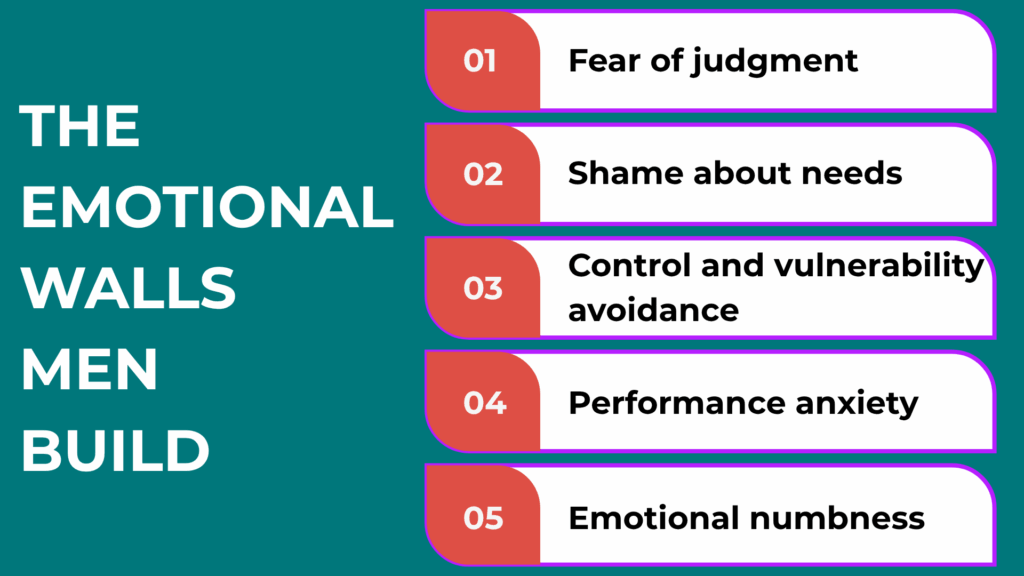
Common emotional barriers men carry into sexual relationships:
- Fear of judgment – Worrying that your desires or performance will be criticized
- Shame about needs – Feeling guilty for wanting sex or specific types of touch
- Control and vulnerability avoidance – Staying guarded to avoid emotional risk
- Performance anxiety – Focusing on how you’re doing rather than what you’re experiencing
- Emotional numbness – Disconnecting from feelings to avoid vulnerability
Why these barriers develop:
- Past experiences of rejection or criticism
- Cultural messages about masculine emotional expression
- Trauma or negative sexual experiences
- Relationship conflicts that haven’t been resolved
- General life stress that affects emotional availability
How these barriers kill sexual pleasure:
- They prevent authentic arousal and desire
- They create distance between you and your partner
- They make sex feel performative rather than pleasurable
- They block communication about what actually feels good
- They create anxiety that interferes with physical function
Performance Anxiety vs. Connection Anxiety
Most men think their sexual anxiety is about performance. Often, it’s actually about connection.

Performance anxiety sounds like:
- “What if I don’t last long enough?”
- “What if I can’t get hard?”
- “What if she’s not satisfied?”
- “What if I’m not as good as her past partners?”
Connection anxiety sounds like:
- “What if she doesn’t really want me?”
- “What if I’m not enough for her?”
- “What if I show how I really feel and she rejects me?”
- “What if I let my guard down and get hurt?”
Study on performance anxiety vs. intimacy anxiety in men found that connection anxiety was a stronger predictor of sexual problems than performance anxiety.
Why connection anxiety is often worse:
- It affects desire, not just performance
- It creates emotional distance that compounds physical problems
- It’s harder to address with technique or medical solutions
- It affects the relationship overall, not just sexual encounters
- It often stems from deeper attachment and self-worth issues
When Past Experiences Block Present Pleasure
Your sexual response is influenced by every sexual experience you’ve ever had.
Common past experiences that affect current sexual pleasure:
- Rejection or criticism from previous partners
- Traumatic or negative sexual experiences of any kind
- Shame or guilt around sexuality from family or cultural messages
- Performance failures that created lasting anxiety
- Relationship betrayals that affected trust and emotional safety
How past experiences show up in current relationships:
- Difficulty being fully present during sex
- Avoiding certain positions, activities, or types of touch
- Feeling anxious or disconnected even with a loving partner
- Inability to communicate desires or needs clearly
- Physical symptoms like difficulty with arousal or performance
The healing approach:
- Recognize that past experiences affect current responses
- Create safety to process and talk about relevant past experiences
- Work with your partner to build new, positive associations
- Consider professional help for trauma or significant barriers
- Focus on creating positive experiences that override negative patterns
[Link to: The Sexless Relationship: What It Means (and What to Do)]
Building Emotional Safety for Better Sex
Emotional safety isn’t just nice to have in a sexual relationship. It’s essential for accessing your full sexual potential.
Creating the Right Emotional Environment
Emotional safety in sexual context means:
- Both partners feel free to express desires without judgment
- Mistakes or “failures” don’t result in criticism or rejection
- Communication about preferences is welcomed and encouraged
- Both partners can be vulnerable without fear of it being used against them
- The focus is on mutual pleasure rather than individual performance
How to assess emotional safety in your relationship:
- Can you talk openly about what you want sexually?
- Do you feel accepted even when sexual encounters aren’t perfect?
- Can you express insecurity or uncertainty without being judged?
- Does your partner respond supportively when you’re vulnerable?
- Do you feel emotionally connected during and after sex?
Red flags for emotional unsafety:
- Criticism or mockery of sexual performance or desires
- Using sexual issues as weapons during arguments
- Pressure to perform or participate when you’re not in the mood
- Judgment or shame around normal sexual needs or preferences
- Feeling like you have to pretend or perform to be accepted
Trust, Acceptance, and Sexual Freedom
Sexual freedom comes from feeling completely accepted by your partner.
When you know you won’t be judged, criticized, or rejected for your authentic sexual self, you can relax into genuine pleasure and connection.
Building sexual trust:
- Start with non-sexual emotional intimacy – Share feelings and vulnerabilities outside the bedroom
- Practice non-judgmental communication – Listen without trying to fix or change your partner
- Honor boundaries consistently – Respect limits without pressure or resentment
- Share your own vulnerabilities – Model the emotional openness you want to receive
- Respond supportively to disclosures – Make it safe for your partner to be honest with you
Signs of sexual trust and acceptance:
- You can share fantasies without fear of judgment
- Performance anxiety decreases over time in the relationship
- Both partners can initiate and decline sex comfortably
- Experimentation and exploration feel safe and fun
- Mistakes or awkward moments become shared jokes rather than sources of shame
The Foundation Work That Changes Everything
The real work of building emotional intimacy happens outside the bedroom.
Daily practices that build emotional-sexual connection:
- Regular check-ins about feelings, stress, and emotional needs
- Physical affection without sexual expectation – Hugs, kisses, cuddling
- Quality time focused on connection – Conversations without distractions
- Emotional support during stress – Being there for each other during difficult times
- Appreciation and gratitude – Regularly expressing what you value about your partner
Weekly practices:
- Dedicated time for deeper conversation about the relationship
- Planning for intimacy (both emotional and physical)
- Addressing any conflicts or tensions before they build up
- Sharing goals and dreams for the future
- Reviewing what’s working well and what could improve
Monthly practices:
- Relationship check-ins about overall satisfaction and connection
- Planning special experiences together (sexual and non-sexual)
- Discussing any changes in desires, needs, or circumstances
- Celebrating relationship milestones and growth
- Setting intentions for continued emotional and sexual growth
[Link to: From Disconnected to Desired: Rebuilding Intimacy After Kids, Work, and Stress]
Practical Skills for Emotional Intimacy
Emotional intimacy is a skill set, not a personality trait. You can learn these skills regardless of your natural inclinations or past experiences.
Learning to Express What You Actually Feel
Most men struggle to identify and express emotions because we were never taught how.
Common emotional expression challenges for men:
- Limited emotional vocabulary beyond “good,” “bad,” “fine,” and “angry”
- Difficulty distinguishing between different emotional states
- Tendency to intellectualize rather than feel emotions
- Fear that expressing emotions will make you seem weak or needy
- Lack of practice in emotional self-awareness and expression
Building emotional expression skills:
- Expand your emotional vocabulary – Learn words for different feeling states
- Practice emotional check-ins – Regularly ask yourself how you’re feeling
- Use “I feel” statements – Express emotions directly rather than through behavior
- Share emotions in real-time – Don’t wait until feelings build up or explode
- Connect emotions to physical sensations – Notice how feelings show up in your body
Practical exercises:
- Daily emotion logging – Write down 3 emotions you experienced each day
- Emotion wheel practice – Use an emotion wheel to identify specific feelings
- Partner check-ins – Share one emotion with your partner each day
- Body scanning – Notice physical sensations and connect them to emotions
- Emotional storytelling – Share experiences that brought up strong emotions
Reading and Responding to Your Partner’s Emotions
Emotional intimacy is a two-way street. You need to tune in to your partner’s emotional world as well as sharing your own.
Signs you might be missing your partner’s emotional cues:
- Your partner says you don’t understand them
- Conflicts seem to come out of nowhere
- Your partner withdraws emotionally or sexually
- You feel like you’re walking on eggshells
- Your attempts to help or fix things often backfire
Developing emotional attunement:
- Listen for emotions behind words – Pay attention to tone, not just content
- Ask about feelings, not just facts – “How are you feeling about that?” rather than “What happened?”
- Reflect back what you hear – “It sounds like you’re feeling frustrated about…”
- Validate emotions even when you don’t agree – “That makes sense that you’d feel that way”
- Ask how you can support – “What do you need from me right now?”
Common mistakes in emotional response:
- Trying to fix problems instead of acknowledging feelings
- Minimizing emotions (“It’s not that big a deal”)
- Taking emotions personally when they’re not about you
- Offering solutions when your partner just wants to be heard
- Defending yourself instead of listening to your partner’s experience
Timing and Context: When to Go Deeper
Emotional intimacy requires good timing and appropriate context.
Good times for deeper emotional sharing:
- When both partners are calm and not distracted
- During dedicated relationship time without interruptions
- After positive shared experiences that create connection
- When one partner explicitly asks for emotional support
- During regular relationship check-ins or conversations
Poor times for emotional intimacy:
- During conflicts or high-stress situations
- When either partner is tired, hungry, or overwhelmed
- In public or around other people
- During sexual activity (unless it naturally arises)
- When there are pressing practical matters to address
Creating the right context:
- Set aside dedicated time for meaningful conversation
- Minimize distractions (phones, TV, other interruptions)
- Choose comfortable, private settings
- Approach conversations with curiosity rather than judgment
- Be prepared to listen more than you speak
[Link to: How to Talk About Sex with Your Partner (Without Making It Weird)]
Overcoming Resistance to Vulnerability
Your brain is wired to resist vulnerability because it perceives emotional openness as a threat to survival and social status.
Understanding this resistance helps you work with it rather than against it.
Why Your Brain Fights Emotional Openness
Evolutionary and cultural reasons your brain resists vulnerability:
- Social status protection – Vulnerability can be perceived as weakness that lowers status
- Rejection avoidance – Opening up creates risk of being hurt or rejected
- Control maintenance – Vulnerability requires giving up some control over how others see you
- Masculine conditioning – Cultural messages that equate emotion with weakness
- Past hurt protection – Previous experiences of vulnerability being punished or rejected
How resistance shows up:
- Deflecting serious conversations with humor or changing the subject
- Intellectualizing emotions rather than feeling them
- Getting angry or defensive when asked about feelings
- Avoiding situations that might require emotional openness
- Feeling physically uncomfortable when conversations get deep
The paradox: The very defenses that protect you from emotional risk also prevent you from getting the connection and intimacy you want.
Gradual Exposure: Building Emotional Courage
Like any fear, resistance to vulnerability decreases with gradual, safe exposure.
Starting small with emotional risk-taking:
- Share low-stakes emotions first – Talk about feelings related to work, hobbies, or daily experiences
- Practice with trusted friends – Build emotional expression skills in less risky relationships
- Use structured sharing – Try relationship exercises or guided conversations
- Start with positive emotions – Share appreciation, excitement, or gratitude before moving to more vulnerable feelings
- Focus on the present – Share what you’re feeling right now rather than deep past experiences
Building emotional courage over time:
- Notice that sharing emotions usually brings people closer, not further apart
- Practice self-compassion when vulnerability feels awkward or difficult
- Celebrate small wins in emotional expression and connection
- Work with a therapist if past trauma makes vulnerability particularly difficult
- Remember that emotional skills improve with practice, like any other skill
Reframing Vulnerability as Strength
The masculine reframe that makes vulnerability accessible:
Traditional view: Real men don’t show emotions or need deep connection Empowered view: Emotionally intelligent men create the relationships and life satisfaction they want
Vulnerability as masculine strength:
- Courage – It takes balls to be genuine in a world that rewards pretending
- Leadership – Emotional openness models healthy masculinity for other men
- Effectiveness – Emotional skills help you get your needs met and build the relationships you want
- Authenticity – Being real is more attractive than trying to be perfect
- Resilience – Men with strong emotional connections handle life stress better
Practical reframes:
- “I’m working on my relationship skills” instead of “I’m getting soft”
- “I’m building intimacy” instead of “I’m being vulnerable”
- “I’m developing emotional intelligence” instead of “I’m sharing feelings”
- “I’m creating the sex life I want” instead of “I’m being emotional”
- “I’m investing in my relationship” instead of “I’m opening up”
Long-Term Strategies for Sustained Connection
Building emotional intimacy isn’t a one-time achievement. It’s an ongoing practice that requires consistent attention and effort.
Emotional Maintenance vs. Crisis Management
Most couples only focus on emotional connection when there’s a crisis. But emotional intimacy, like physical health, requires regular maintenance.
Crisis management approach:
- Ignore emotional needs until there’s a major problem
- Only have deep conversations during conflicts
- Wait for your partner to demand more connection
- Use emotional openness as a tool to fix immediate problems
- Return to old patterns once the immediate crisis passes
Maintenance approach:
- Regular emotional check-ins and connection time
- Ongoing attention to relationship satisfaction and intimacy
- Proactive communication about changing needs and desires
- Consistent practices that build emotional safety and trust
- Investment in emotional and sexual growth over time
Building maintenance habits:
- Daily emotional connection – Share one meaningful thing with your partner each day
- Weekly relationship time – Dedicated time for deeper conversation and planning
- Monthly relationship reviews – Discuss what’s working and what could improve
- Annual relationship visioning – Set goals and intentions for growth and connection
- Regular professional support – Couples counseling or relationship education as needed
Growing Together Instead of Growing Apart
People change over time. The question is whether you’ll grow together or grow apart.
Common ways couples grow apart:
- Pursuing individual interests without including your partner
- Avoiding difficult conversations about changing needs or desires
- Taking each other for granted as the relationship becomes routine
- Focusing on external achievements while neglecting relationship investment
- Assuming your partner’s needs and desires remain the same over time
Strategies for growing together:
- Regular relationship visioning – Discuss your hopes and dreams for the future
- Shared growth experiences – Take classes, travel, or pursue new interests together
- Individual growth sharing – Talk about how you’re changing and evolving as a person
- Adaptive communication – Adjust your relationship patterns as life circumstances change
- Intentional novelty – Regularly try new things together to prevent stagnation
Navigating major life transitions:
- Career changes and work stress
- Having children or becoming empty nesters
- Health challenges or aging concerns
- Financial stress or major purchases
- Family issues or loss of loved ones
Each transition requires renegotiating emotional and sexual intimacy for your new circumstances.
Keeping Passion Alive Through Life Changes
Passion doesn’t automatically fade with time. It fades with neglect.
What kills passion over time:
- Taking each other for granted
- Prioritizing everything else over the relationship
- Avoiding novelty and challenge in the relationship
- Letting emotional intimacy deteriorate
- Focusing on problems rather than appreciation
What sustains passion:
- Continued emotional growth – Keep getting to know each other as you change
- Intentional novelty – Regularly create new shared experiences
- Appreciation practice – Focus on what you love about your partner
- Physical affection – Maintain non-sexual touch and closeness
- Sexual communication – Keep talking about desires and trying new things
Practical passion maintenance:
- Plan regular date nights and relationship experiences
- Express appreciation and gratitude daily
- Maintain individual interests that make you interesting to your partner
- Create anticipation for time together
- Focus on giving pleasure rather than just receiving it
[Link to: Tantra for Men: What It Is (and What It’s Not)]
When Professional Help Makes the Difference
Sometimes the barriers to emotional and sexual intimacy require professional support to overcome.
Individual vs. Couples Therapy for Sexual Issues
When to consider individual therapy:
- Past trauma that affects current intimate relationships
- Severe anxiety or depression that impacts sexual function
- Addiction issues that interfere with emotional availability
- Deep-seated beliefs about masculinity or sexuality that create barriers
- Individual emotional skills that need development before couples work
When to consider couples therapy:
- Communication patterns that consistently lead to conflict
- Different levels of desire for emotional or sexual intimacy
- Unresolved conflicts that affect sexual connection
- Major life transitions that are straining the relationship
- Need for structured support in building intimacy skills
When to consider sex therapy specifically:
- Sexual trauma or dysfunction that affects intimate relationships
- Significant differences in sexual desires or preferences
- Performance anxiety that doesn’t improve with self-help approaches
- Need for education about sexual anatomy and function
- Specialized issues like premature ejaculation or erectile dysfunction
Recognizing Trauma That Affects Intimacy
Trauma doesn’t always look like major, obvious events. Sometimes it’s subtler experiences that still affect your ability to be emotionally and sexually intimate.
Types of experiences that can affect intimacy:
- Sexual trauma – Any unwanted or harmful sexual experiences
- Emotional abuse – Criticism, contempt, or rejection in past relationships
- Childhood experiences – Family dysfunction, neglect, or inappropriate boundaries
- Religious or cultural shame – Negative messages about sexuality or emotional expression
- Relationship betrayals – Infidelity, lies, or broken trust in past relationships
Signs trauma may be affecting your intimate relationships:
- Difficulty being present during sexual activity
- Avoiding certain types of touch or sexual activities
- Emotional numbing or disconnection during intimacy
- Severe anxiety or panic related to vulnerability
- Patterns of sabotaging close relationships
Getting appropriate help:
- Trauma-informed therapists who understand how past experiences affect current relationships
- EMDR or other specialized trauma treatments if needed
- Support groups for men dealing with specific types of trauma
- Couples therapy that addresses trauma’s impact on the relationship
- Medical evaluation if trauma symptoms include physical effects
Finding the Right Professional Support
Not all therapists are equally skilled in relationship and sexual issues.
What to look for in a therapist:
- Specialization in couples or sex therapy – Specific training in relationship and sexual issues
- Male-friendly approach – Understanding of how men experience and express emotions
- Trauma-informed practice – If trauma is a factor in your situation
- Evidence-based approaches – Therapists trained in methods with research support
- Good fit and rapport – You feel comfortable and understood
Questions to ask potential therapists:
- What is your training and experience with couples/sexual issues?
- How do you typically work with men who struggle with emotional intimacy?
- What is your approach to addressing sexual issues in relationships?
- How do you handle situations where partners have different communication styles?
- What can we expect from the therapy process?
Making therapy work:
- Be honest about your goals and concerns
- Do homework assignments and practice new skills
- Be patient with the process – change takes time
- Focus on your own growth rather than trying to change your partner
- Communicate openly with your therapist about what is and isn’t working
Your Emotional-Sexual Health Action Plan
Understanding the connection between emotional health and sexual pleasure is just the beginning. Real change comes from consistent practice and application.
Your immediate next steps:
- Assess your current level of emotional intimacy and sexual satisfaction
- Identify the biggest barriers to emotional connection in your relationship
- Choose 2-3 specific skills to practice this week
- Have an honest conversation with your partner about what you’re learning
- Consider professional support if needed for individual or relationship issues
For building long-term emotional-sexual health:
- Develop regular practices for emotional connection and intimacy
- Learn to express emotions clearly and respond to your partner’s emotions supportively
- Create emotional safety in your relationship that supports sexual freedom
- Address any past experiences or current issues that interfere with intimacy
- View emotional and sexual growth as ongoing investments in your relationship
Remember these key insights:
- Emotional connection is the strongest predictor of sexual satisfaction
- Vulnerability is a masculine strength, not a weakness
- Building emotional intimacy requires practice and patience
- Professional help is normal and effective for relationship issues
- Great sex starts with emotional safety and authentic connection
Additional resources for your journey:
- [Link to: Why Great Sex Starts Outside the Bedroom]
- [Link to: The Sexless Relationship: What It Means (and What to Do)]
- [Link to: How to Talk About Sex with Your Partner (Without Making It Weird)]
- [Link to: From Disconnected to Desired: Rebuilding Intimacy After Kids, Work, and Stress]
- [Link to: Tantra for Men: What It Is (and What It’s Not)]
The bottom line: You can have technically perfect sex and still feel empty, or you can have imperfect sex with deep emotional connection and feel completely satisfied.
The difference isn’t in your performance. It’s in your willingness to be vulnerable, authentic, and emotionally present with your partner.
Great sex isn’t something you do. It’s something you experience together. And that experience is only as deep as your emotional connection allows it to be.
You deserve more than mechanical sex that leaves you feeling empty. You deserve the kind of intimate connection that feeds your soul and makes you feel truly alive.
The path there starts with emotional courage. Everything else follows.
Starting Where You Are (Not Where You Think You Should Be)
Most men make the mistake of trying to become emotionally intimate all at once. This usually backfires and creates more resistance.
Realistic starting points:
- Share one emotion with your partner each day
- Ask one question about your partner’s feelings each week
- Practice emotional vocabulary by naming your feelings to yourself
- Express appreciation for your partner daily
- Have one meaningful conversation per week without distractions
Don’t start with:
- Sharing your deepest fears and insecurities
- Expecting to transform your communication overnight
- Pressuring your partner to become more emotionally expressive
- Trying to fix every relationship issue at once
- Assuming that emotional intimacy will automatically improve your sex life immediately
Building Skills Without Overwhelming Your Partner
Your emotional growth might feel threatening to your partner initially, especially if it represents a significant change from your usual communication style.
How to introduce emotional intimacy gradually:
- Start with appreciation – Share what you value about your partner before diving into deeper emotions
- Ask permission – “I’d like to share something I’m feeling. Is this a good time?”
- Be consistent but not overwhelming – Regular small steps rather than dramatic emotional downloads
- Model the behavior you want – Share your own emotions before expecting your partner to open up
- Respect your partner’s pace – Don’t push for more emotional intimacy than your partner is comfortable with
Signs you might be moving too fast:
- Your partner seems overwhelmed or withdraws when you share emotions
- Conversations about feelings turn into arguments
- Your partner makes jokes or changes the subject when things get deep
- You feel frustrated that your partner isn’t matching your emotional openness
- The focus becomes more about getting your partner to change than your own growth
Measuring Progress in Connection, Not Just Performance
Traditional metrics of sexual success miss the point of emotional-sexual health.
Connection-based measures of progress:
- Emotional safety – Do you feel comfortable being vulnerable with your partner?
- Communication quality – Can you talk openly about desires, concerns, and feelings?
- Present-moment awareness – Are you mentally and emotionally present during intimate moments?
- Mutual satisfaction – Do both partners feel heard, understood, and valued?
- Relationship satisfaction – Is your overall connection improving over time?
Performance-based metrics to avoid obsessing over:
- Duration of sexual encounters
- Frequency of sexual activity
- Orgasm consistency or intensity
- Comparison to past sexual experiences
- Meeting arbitrary standards of sexual performance
Healthy progress tracking:
- Notice improvements in emotional comfort and communication
- Pay attention to increased satisfaction and connection during intimacy
- Observe reduced anxiety and increased presence during sexual activity
- Track overall relationship satisfaction and emotional intimacy
- Celebrate small wins in vulnerability and emotional expression
Frequently Asked Questions About Emotional Intimacy and Sex
Q: How does emotional connection actually improve physical sexual pleasure? Emotional safety allows your nervous system to fully relax, which enhances physical sensitivity and arousal. When you feel emotionally connected, your brain releases hormones like oxytocin that literally increase pleasure and bonding.
Q: Can you have good sex without emotional intimacy? You can have physically satisfying sex without deep emotional connection, but research shows it’s less fulfilling long-term. Emotional intimacy is what transforms sex from a physical act into a meaningful experience that builds relationship satisfaction.
Q: Why do men struggle more with emotional intimacy than women? Cultural conditioning teaches men to suppress emotions and avoid vulnerability. This isn’t biological—it’s learned behavior that can be unlearned. Men who develop emotional intelligence often report better relationships and sexual satisfaction.
Q: What’s the difference between performance anxiety and connection anxiety? Performance anxiety focuses on physical function—”What if I can’t perform?” Connection anxiety focuses on emotional safety—”What if my partner doesn’t really want me?” Connection anxiety often underlies performance issues.
Q: How do I become more emotionally intimate without feeling weak? Reframe vulnerability as strength and emotional intelligence as an advanced masculine skill. Men who can be authentic and emotionally present are more attractive and successful in relationships, not less.
Q: Can improving emotional connection fix sexual problems in my relationship? Emotional connection often improves sexual issues, especially those related to desire, satisfaction, and communication. However, some problems may also need medical evaluation or specialized therapy.
Q: How long does it take to build better emotional intimacy? You can start seeing improvements in weeks with consistent practice, but deep emotional intimacy develops over months and years. The key is consistency rather than intensity.
Q: What if my partner wants more emotional connection than I’m comfortable with? Start with small steps and be honest about your comfort level while committing to growth. Consider couples therapy to help navigate different needs and communication styles.
Q: Is it normal for emotional intimacy to feel scary or overwhelming? Absolutely normal, especially for men who weren’t taught emotional expression skills. The fear usually decreases with practice and positive experiences of emotional sharing.
Q: When should couples seek professional help for intimacy issues? Consider professional help if communication consistently leads to conflict, if there are significant differences in intimacy needs, or if past trauma affects current relationships. Early intervention often prevents bigger problems.
Disclaimer: This content is for informational purposes only and is not a substitute for professional medical advice, diagnosis, or treatment. Always seek the advice of your physician or other qualified health provider with any questions you may have regarding a medical condition.


