

Table of Contents
You know that moment when you’re in back-to-back meetings, your stress is through the roof, and you feel like you can’t catch your breath?
Your chest feels tight. Your mind is racing. You’re breathing shallow, rapid breaths that somehow make you feel more anxious, not less.
And you’re thinking: “There has to be a better way to handle this.”
Here’s what most men don’t realize: your breath is the most powerful tool you have for controlling your energy, stress, and performance. But you’ve never been taught how to use it.
You probably spend more time thinking about your car’s air filter than the air going into your lungs. But here’s the thing—learning to breathe properly can give you instant energy when you need it, calm your stress in real-time, and build the kind of resilience that separates high performers from everyone else.
You’re Breathing Wrong (And It’s Costing You Energy)
Let’s be honest about what’s happening with your breathing right now.
You’re probably breathing through your mouth, taking shallow breaths that only fill the top third of your lungs, and you’re doing it 12-20 times per minute when optimal breathing is closer to 6-8 breaths per minute.
The result? You’re in a constant state of low-level stress, even when you think you’re relaxed.
The Hidden Cost of Poor Breathing
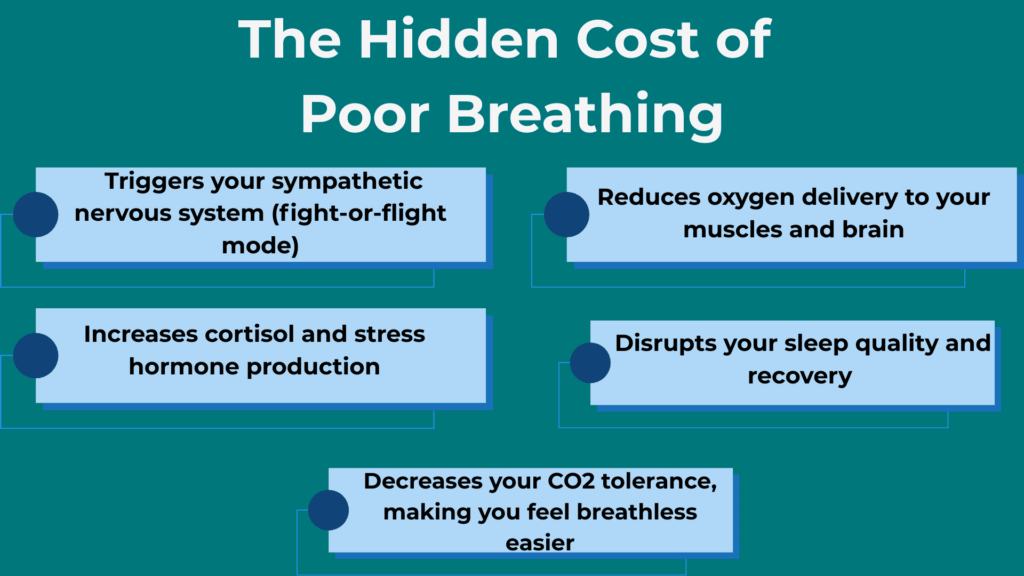
What shallow, mouth breathing actually does to your body: • Triggers your sympathetic nervous system (fight-or-flight mode) • Reduces oxygen delivery to your muscles and brain • Increases cortisol and stress hormone production • Disrupts your sleep quality and recovery • Decreases your CO2 tolerance, making you feel breathless easier
The emotional cost: You feel like you’re always “running on empty,” even when you haven’t done anything particularly stressful.
Why Most Men Never Think About Their Breath
Here’s the thing: breathing feels automatic, so we assume it doesn’t need attention.
But automatic doesn’t mean optimal.
Most men will spend hours optimizing their workout, their diet, their sleep—but they ignore the one thing they do 20,000 times a day that directly affects all of those other things.
Why breathing gets ignored: • It seems too simple to be important • We associate “breathing exercises” with meditation or yoga • Nobody teaches us proper breathing technique • The benefits aren’t immediately obvious • It feels like something only stressed people need to worry about
The reality: Elite athletes, Navy SEALs, and high-performing executives all have one thing in common—they’ve mastered their breathing.
Your Breath Controls More Than You Realize
Your breathing directly controls your autonomic nervous system—the part of your nervous system that manages everything from your heart rate to your digestion.
The Science Behind Breathing and Performance
What happens when you control your breathing: • You can shift from stressed to calm in under 60 seconds • You can increase energy and alertness without caffeine • You can improve focus and cognitive performance • You can enhance recovery and sleep quality • You can build stress resilience over time
The mechanism is simple: When you breathe slowly and deeply, you activate your parasympathetic nervous system (rest and digest mode). When you breathe quickly and shallowly, you activate your sympathetic nervous system (fight or flight mode).
The game-changer: You can choose which state you want to be in, when you want to be in it.
How Your Breathing Affects Energy, Stress, and Focus
For energy: • Specific breathing patterns increase alertness and motivation • Proper oxygenation improves mental clarity • Controlled breathing can replace your afternoon coffee
For stress: • Slow, deep breathing activates your body’s relaxation response • You can literally breathe your way out of anxiety • Works faster than most stress management techniques
For focus: • Breathing exercises improve attention span and concentration • Helps filter out distractions and mental noise • Creates a state of “calm alertness” ideal for performance
Nasal vs. Mouth Breathing: The Difference That Changes Everything
Here’s a hard truth: If you’re breathing through your mouth during the day, you’re sabotaging your health.
Why nasal breathing is superior: • Filters, warms, and humidifies the air before it hits your lungs • Produces nitric oxide, which improves oxygen delivery • Engages your diaphragm more effectively • Naturally slows your breathing rate • Activates your parasympathetic nervous system
When mouth breathing becomes a problem: • During sleep (leads to snoring, poor sleep quality) • During low-intensity exercise (reduces efficiency) • Throughout the day (increases stress and reduces focus) • When you’re already stressed (amplifies the stress response)
For a complete breakdown: [Link to: Nasal Breathing vs. Mouth Breathing: Why It Matters More Than You Think]
Breathing for Energy: Wake Up Your System
When you need energy, most men reach for coffee. Here’s a better option that works in 2-3 minutes.
The 4-7-8 Technique for Instant Energy
This isn’t your typical “relaxation” breathing—this is designed to energize.
The energizing breath protocol: • Inhale through your nose for 4 counts • Hold your breath for 7 counts • Exhale forcefully through your mouth for 8 counts • Repeat 4-6 cycles
What this does: • Increases oxygen saturation in your blood • Activates your sympathetic nervous system in a controlled way • Improves circulation and mental alertness • Gives you natural energy without the crash
When to use it: • Instead of your second cup of coffee • Before important meetings or presentations • When you hit that afternoon energy slump • Before workouts to prime your nervous system
Power Breathing for Pre-Workout Activation
This technique primes your body for physical performance:
The power breathing sequence: • Take 10-15 deep, rapid breaths through your nose • Hold your breath for 15-30 seconds after the last exhale • Take one deep breath and hold for 10-15 seconds • Exhale slowly and begin your workout
What you’ll notice: • Increased energy and motivation • Better mind-muscle connection • Improved focus during training • Enhanced endurance and power output
CO2 Tolerance Training for Better Oxygenation
Most people think they need more oxygen. Actually, you need better CO2 tolerance.
The CO2 tolerance test: • Take a normal breath and exhale completely • Time how long you can comfortably hold your breath • Less than 20 seconds = poor CO2 tolerance • 20-40 seconds = average • 40+ seconds = good tolerance
Why CO2 tolerance matters: • Better CO2 tolerance means better oxygen delivery • Improves your body’s ability to handle physical stress • Reduces the feeling of breathlessness during exercise • Enhances overall respiratory efficiency
For detailed energy breathing protocols: [Link to: How to Breathe for Energy: Oxygenation Techniques You Can Use Today]
Breathing for Stress: Your Emergency Reset Button
When stress hits, your breathing changes. But you can reverse-engineer this process.
Box Breathing for High-Pressure Situations
This is the technique Navy SEALs use to stay calm under pressure.
The box breathing protocol: • Inhale through your nose for 4 counts • Hold your breath for 4 counts • Exhale through your nose for 4 counts • Hold empty for 4 counts • Repeat for 4-8 cycles
Why this works: • Forces your nervous system to shift gears • Gives your mind something specific to focus on • Regulates your heart rate variability • Can be done anywhere without anyone noticing
When to use box breathing: • Before difficult conversations • During traffic or travel stress • When you feel overwhelmed at work • Before important decisions
The Physiological Sigh for Instant Calm
This is the fastest way to calm your nervous system:
The double-inhale technique: • Take a normal inhale through your nose • Before exhaling, take a second, smaller inhale (topping off your lungs) • Exhale slowly and completely through your mouth • Repeat 2-3 times
Research shows this technique can reduce stress markers within 60 seconds.
Why it’s so effective: • Maximizes the calming effect of exhalation • Quickly shifts your autonomic nervous system • Mimics your body’s natural stress-release mechanism • Works even when you’re already highly stressed
When to Use Which Technique
For immediate stress relief (0-2 minutes): • Physiological sigh for instant calm • Use when you need to reset quickly
For sustained calm (2-10 minutes): • Box breathing for deeper relaxation • Use when you have a few minutes to decompress
For long-term stress resilience: • Daily breathing practice • Build your stress tolerance over time
For comprehensive stress breathing methods: [Link to: Breath as a Stress Tool: Calm Down or Power Up on Demand]
Advanced Breathwork: Building Long-Term Resilience
Once you’ve mastered the basics, these advanced techniques can significantly upgrade your stress tolerance and performance.
Wim Hof Method vs. Other Cold Exposure Breathing
The Wim Hof breathing technique: • 30-40 deep, rapid breaths (fully in, relaxed out) • Hold your breath after the last exhale (1-3 minutes) • Take a deep breath and hold for 15 seconds • Repeat for 3-4 rounds
What this does: • Increases your stress tolerance • Improves your ability to handle discomfort • Enhances immune function • Builds mental resilience
The key difference from other methods: • More intense and activating • Designed to build stress resilience, not just relaxation • Prepares your body for challenges (like cold exposure) • Creates a controlled stress response
Training Your Oxygen Advantage
The concept: Train your body to do more with less oxygen.
Breath-holding progressions: • Start with comfortable breath holds after exhaling • Gradually increase duration over weeks • Practice during light movement (walking) • Build up to more challenging holds
Benefits of oxygen advantage training: • Improved athletic performance • Better stress tolerance • Enhanced focus and mental clarity • Increased energy efficiency
Building CO2 Tolerance for Better Performance
Progressive CO2 tolerance training: • Week 1-2: Focus on nasal breathing during all daily activities • Week 3-4: Add breath-holding exercises • Week 5-6: Practice reduced breathing (breathing less than you want to) • Week 7-8: Combine with light exercise
The goal: Make your body comfortable with higher CO2 levels, which paradoxically improves oxygen delivery.
For detailed advanced techniques: [Link to: Wim Hof, Box Breathing & CO2 Tolerance: What’s the Difference?]
Making Breathwork Work in Your Real Life
The best breathing technique is the one you actually use consistently.
The 5-Minute Morning Breathing Routine
Start your day with intentional breathing:
The morning breath protocol (5 minutes): • 1 minute: Focus on nasal breathing and posture • 2 minutes: Box breathing to center yourself • 2 minutes: Energizing breath to activate your system
Why morning breathing matters: • Sets your nervous system tone for the day • Improves focus and energy naturally • Creates a moment of calm before the chaos starts • Builds the habit when you’re most consistent
Breathing Breaks That Fit Your Schedule
Micro-breathing sessions that work:
The 60-second reset: • 3 physiological sighs • Use between meetings or tasks
The 3-minute recharge: • 2 minutes of box breathing • Use during lunch breaks or commutes
The 5-minute optimization: • Combine energy and stress techniques • Use when transitioning between major activities
The key: Consistency beats duration. Daily 2-minute sessions are better than weekly 20-minute sessions.
Using Breath as Your Stress Management Tool
Create your personal breathing toolkit:
For different situations: • High-pressure meetings: Box breathing beforehand • Afternoon energy crashes: Energizing breath techniques • Evening wind-down: Slow, deep breathing • Pre-sleep: Extended exhales to activate rest mode
Track what works: • Notice which techniques work best for which situations • Pay attention to how quickly you feel the effects • Adjust timing and intensity based on your response • Build your personalized breathing protocol
For complete integration strategies: [Link to: The Oxygen Advantage: Can You Train Your Body to Use Air Better?]
Your 30-Day Breath Mastery Plan

Ready to master your breathing? Here’s your progressive 30-day approach.
Week 1-2: Foundation Building
Days 1-3: Awareness and assessment • Spend the day noticing your breathing patterns • Practice nasal breathing during all daily activities • Do the CO2 tolerance test to establish baseline • Learn the physiological sigh for instant stress relief
Days 4-7: Basic techniques • Add 5 minutes of box breathing to your morning routine • Practice energizing breath when you need coffee • Use breathing for stress relief when situations arise • Focus on nasal breathing during light exercise
Days 8-14: Consistency building • Establish your daily 5-minute morning breathing routine • Add breathing breaks throughout your workday • Experiment with different techniques for different situations • Track which methods work best for you
Week 3-4: Advanced Integration
Days 15-21: Advanced techniques • Try the Wim Hof method or other advanced breathwork • Practice breath-holding exercises to build CO2 tolerance • Use breathing to enhance your workout performance • Experiment with breathing for better sleep
Days 22-30: Optimization and mastery • Fine-tune your personal breathing toolkit • Use breathing proactively, not just reactively • Teach someone else what you’ve learned • Plan your long-term breathing practice
End of 30 days: Assessment and planning • Re-test your CO2 tolerance (should be significantly improved) • Evaluate which techniques provided the most benefit • Create your sustainable long-term breathing routine • Consider how breathing has affected your stress, energy, and performance
Your Next Steps: From Breath Awareness to Mastery
Breathing is the one performance tool that’s always available to you. No equipment needed, no special location required, no monthly subscription.
Here’s your action plan:
Today: • Start breathing through your nose during all daily activities • Learn the physiological sigh for instant stress relief • Try box breathing for 3-5 minutes • Notice how your breathing changes with stress
This week: • Establish a 5-minute morning breathing routine • Use energizing breath instead of afternoon coffee • Practice breathing techniques during real-world stress • Experiment with breathing for better sleep
This month: • Build your personal breathing toolkit for different situations • Try advanced techniques like Wim Hof or CO2 tolerance training • Use breathing to enhance your workouts and performance • Track the correlation between breathing practice and stress levels
This quarter: • Master the ability to shift your state through breathing alone • Use breath as your primary stress management tool • Share breathing techniques with other men who could benefit • Consider breathwork as a foundation for other optimization practices
Remember: Every elite performer—from Navy SEALs to Fortune 500 CEOs—has mastered their breathing. It’s not about perfection; it’s about having a reliable tool you can use anywhere, anytime, to control your energy, stress, and performance.
Your breath is your superpower. You just need to learn how to use it.
Frequently Asked Questions About Breathing Techniques
Q: How long does it take to see results from breathing exercises? A: You can feel immediate effects (stress relief, energy boost) within 1-3 minutes. Long-term benefits like improved stress tolerance and performance typically develop over 2-4 weeks of consistent practice.
Q: Can breathing techniques really reduce stress immediately? A: Yes. Controlled breathing activates your parasympathetic nervous system, which can reduce stress hormones and anxiety within 60 seconds. The physiological sigh is particularly effective for immediate stress relief.
Q: What’s the best breathing technique for beginners? A: Start with nasal breathing throughout the day and learn box breathing (4-4-4-4 pattern). These provide immediate benefits and are easy to practice anywhere.
Q: How often should I practice breathing exercises? A: Daily practice is ideal. Start with 5 minutes in the morning, plus using breathing techniques as needed throughout the day for stress or energy. Consistency matters more than duration.
Q: Can breathing techniques improve my athletic performance? A: Yes. Proper breathing improves oxygen delivery, enhances recovery, and helps you manage stress and focus during competition. Many elite athletes use breathwork as a core part of their training.
Q: Is it normal to feel lightheaded during breathing exercises? A: Mild lightheadedness can occur with intensive breathing techniques like Wim Hof method. Start slowly, practice sitting down, and stop if you feel uncomfortable. This usually improves with practice.
Q: What’s the difference between different breathing methods? A: Different techniques serve different purposes: box breathing for stress relief, energizing breath for alertness, Wim Hof for resilience building. Each targets different aspects of your nervous system.
Q: Can breathing techniques help with sleep? A: Absolutely. Slow, deep breathing with extended exhales activates your rest-and-digest nervous system, helping you fall asleep faster and improving sleep quality.
Disclaimer: This content is for informational purposes only and is not a substitute for professional medical advice, diagnosis, or treatment. Always seek the advice of your physician or other qualified health provider with any questions you may have regarding a medical condition.
Read More Blogs on Breathwork & Oxygen, Stress Management & Resilience
