

Table of Contents
You used to walk into rooms with quiet confidence. Now you avoid eye contact, second-guess every move, and feel like everyone can somehow sense your struggle. You might not even recognize the confidence levels of the man looking at you in the mirror.
Sadly, one disappointing night can turn into weeks of anxiety. Weeks became months of avoidance. And now? Your bedroom insecurities have leaked into every corner of your life.
Sound familiar?
Here’s what nobody tells you: Sexual confidence isn’t just about what happens between the sheets. It’s the foundation of how you show up as a man in the world.
The stakes are higher than you think. When you lose confidence in one of the most fundamental expressions of your masculinity, it ripples out to your leadership, your relationships, and your overall sense of self-worth.
But here’s the good news: That same ripple effect works in reverse.
The Shame Spiral That’s Killing Your Confidence
Ever notice how one bad sexual experience can hijack your entire sense of self?
It starts small. A night when things don’t go as planned. Maybe you finish too quickly, can’t maintain an erection, or just feel disconnected from the experience.
Instead of seeing it as one isolated incident, your brain makes it mean something about who you are as a man.
Why One Bad Night Becomes Your New Identity
Your brain is wired to protect you from future threats.
So when you have a disappointing sexual experience, your subconscious creates a story: “I’m not good enough. I’m broken. I’m not a real man.”
Here’s what’s really happening: Your brain is trying to protect you from future embarrassment by making you hyper-aware of potential failure.
Studies show that shame in men often becomes deeply intertwined with core identity, affecting self-perception across multiple life domains.
Common shame spiral thoughts:
- “She must think I’m pathetic”
- “I’m not the man I used to be”
- “Other men don’t have these problems”
- “I’m failing at the most basic thing”
- “I can’t even satisfy my own partner”
How Sexual Shame Bleeds Into Everything Else
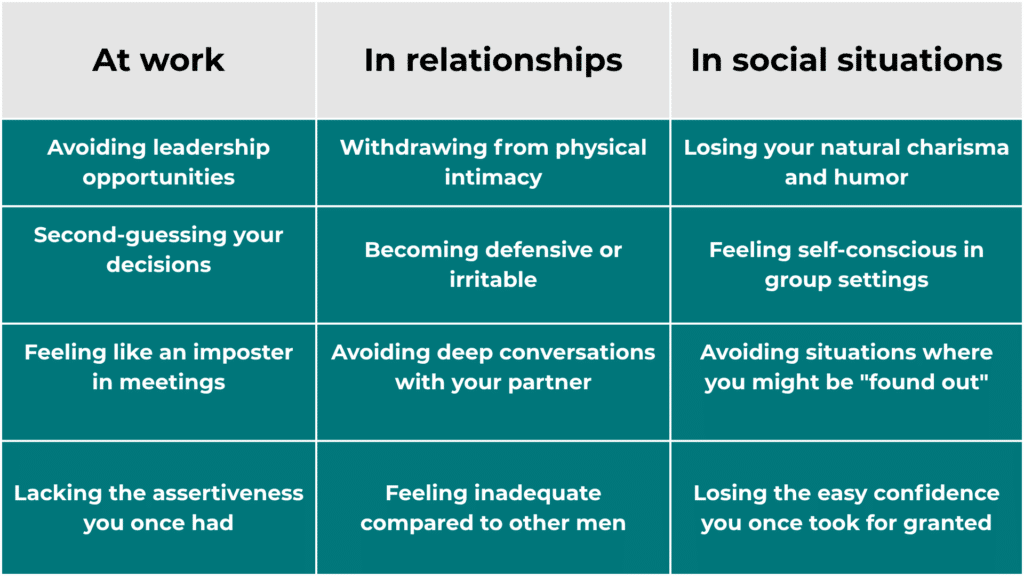
Think sexual confidence only matters in the bedroom?
Think again.
When you’re carrying shame about your sexual performance, it shows up everywhere:
At work:
- Avoiding leadership opportunities
- Second-guessing your decisions
- Feeling like an imposter in meetings
- Lacking the assertiveness you once had
In relationships:
- Withdrawing from physical intimacy
- Becoming defensive or irritable
- Avoiding deep conversations with your partner
- Feeling inadequate compared to other men
In social situations:
- Losing your natural charisma and humor
- Feeling self-conscious in group settings
- Avoiding situations where you might be “found out”
- Losing the easy confidence you once took for granted
The reality is: Sexual confidence and general life confidence are intimately connected. Research confirms that men who feel confident sexually tend to display greater confidence in professional and social settings.
The Mindset Shift That Changes Everything
Here’s where most men get stuck.
They try to fix their sexual confidence by focusing on performance techniques, lasting longer, or becoming a “better lover.”
That’s backwards thinking.
Real sexual confidence doesn’t come from perfect performance. It comes from fundamentally changing how you think about sexuality, masculinity, and what it means to be confident.
From Performance Anxiety to Performance Curiosity
Most men approach sex like a test they need to pass.
“Will I last long enough? Will I get hard? Will I satisfy her? Will I embarrass myself?”
But here’s the thing: When you approach sex as a performance evaluation, you’re already setting yourself up for failure.
The reframe: Instead of “Will I perform well?” ask “What can we discover together?”
Performance mindset:
- Focused on avoiding failure
- Rigid expectations and outcomes
- Fear-based decision making
- Self-conscious and analytical
Curiosity mindset:
- Focused on connection and exploration
- Open to whatever happens
- Playfulness and experimentation
- Present and engaged
This isn’t just positive thinking – it’s a neurological shift. Neuroscience research shows that curiosity activates different brain regions than performance anxiety, literally changing your physiological response.
Redefining What Makes You a “Real Man”
Let’s address the elephant in the room.
Most men tie their masculine identity to sexual performance. But what if that entire framework is keeping you trapped?
Traditional masculine sexual identity:
- Always ready for sex
- Never struggles with performance
- Dominates and controls the experience
- Measures success by partner’s physical response
- Never shows vulnerability or uncertainty
Evolved masculine sexual identity:
- Present and responsive to the moment
- Communicates openly about desires and concerns
- Collaborates in creating mutual pleasure
- Measures success by connection and intimacy
- Comfortable with vulnerability as strength
Here’s the truth: The most sexually confident men aren’t the ones who never have problems – they’re the ones who handle challenges with grace, humor, and self-compassion.
The Four Mental Reframes That Build Unshakeable Confidence
Ready to rebuild your sexual confidence from the ground up?
These aren’t just mindset shifts – they’re fundamental rewiring of how you approach intimacy and masculinity.
Reframe 1: From Perfection to Connection
Old thinking: “I need to perform perfectly to be a good lover.”
New thinking: “Great sex is about creating connection, not flawless execution.”
Why this works: When you focus on connection instead of performance, you naturally become more present, responsive, and attuned to your partner’s needs.
Practical application:
- Before intimacy, take three deep breaths and set an intention to connect
- Focus on eye contact and emotional presence during foreplay
- Ask your partner what feels good instead of assuming you should know
- Celebrate moments of laughter, tenderness, and genuine connection
Reframe 2: From Proving to Playing
Old thinking: “I need to prove I’m a real man through sexual performance.”
New thinking: “Sex is play between adults – it’s supposed to be fun.”
Why this works: Playfulness activates your parasympathetic nervous system, reducing performance anxiety and increasing natural arousal response.
Practical application:
- Approach sex with curiosity about what you’ll discover together
- Laugh off awkward moments instead of letting them derail you
- Experiment with new positions, timing, or approaches without pressure
- Focus on pleasure (yours and theirs) rather than proving anything
Reframe 3: From Avoiding to Approaching
Old thinking: “I should avoid intimacy until I fix my problems.”
New thinking: “I build confidence through practice, not avoidance.”
Why this works: Avoidance reinforces shame and fear. Approach (with the right mindset) builds resilience and actual experience.
Practical application:
- Schedule regular intimate time, even if it doesn’t lead to sex
- Practice non-sexual physical intimacy daily
- Communicate openly about your concerns instead of hiding them
- View every intimate encounter as data, not a judgment
Reframe 4: From Victim to Victor
Old thinking: “I’m broken and there’s nothing I can do about it.”
New thinking: “I’m actively building the sexual confidence I want.”
Why this works: Taking ownership shifts you from passive suffering to active improvement. Studies show that men with an internal locus of control report higher sexual satisfaction and confidence.
Practical application:
- Create a daily confidence-building routine [link to morning routine article]
- Track small wins and improvements in intimacy
- Invest in learning about sexuality, communication, and relationships
- View challenges as opportunities to strengthen your resilience
Building Your Sexual Confidence Foundation
Mental reframes are powerful, but they need to be supported by consistent daily practices that compound your confidence over time.
The Daily Practices That Compound Your Swagger
Morning confidence ritual (5 minutes):
- Stand in front of mirror and make eye contact with yourself
- State three things you appreciate about your body
- Set an intention for how you want to show up as a man today
- Take five deep breaths and visualize yourself as confidently sexual
Throughout the day:
- Practice confident body language in all interactions
- Make genuine eye contact during conversations
- Speak with authority and avoid apologetic language
- Take up appropriate space instead of shrinking
Evening connection ritual:
- Spend 10 minutes in non-sexual physical contact with your partner
- Share one thing you appreciated about them that day
- Express one thing you’re grateful for about your body
- Practice being present during any intimate moments
How to Handle Setbacks Without Losing Progress
Here’s the reality: You’re going to have disappointing sexual experiences during your confidence-building journey.
The difference between men who build lasting confidence and those who stay stuck is how they handle these setbacks.
When things don’t go as planned:
Immediate response (within 24 hours):
- Avoid the story that this means anything about your worth as a man
- Talk to your partner about what happened without defensiveness
- Practice self-compassion instead of self-criticism
- Remind yourself that this is one data point, not a verdict
Recovery strategy (within 1 week):
- Identify what you can learn from the experience
- Adjust your approach based on what you discovered
- Plan your next intimate encounter without pressure
- Focus on connection and pleasure rather than performance
Communicating Confidence (Even When You Don’t Feel It)
Confidence isn’t about never having doubts – it’s about not letting doubts control your actions.
How to communicate with sexual confidence:
With your partner:
- “I’m working on being more present with you”
- “Let’s explore what feels good for both of us”
- “I want to focus on connecting with you tonight”
- “Tell me what you’re enjoying”
With yourself:
- “I’m learning and growing”
- “Every experience teaches me something”
- “I deserve pleasure and intimacy”
- “I’m becoming the lover I want to be”
From the Bedroom to Boardroom: How Sexual Confidence Transforms Everything
This is where it gets interesting.
Sexual confidence doesn’t just improve your sex life – it transforms how you show up in every area of life.
The Leadership Connection You Never Expected

Think about the most naturally confident leaders you know.
They’re not arrogant or aggressive. They’re comfortable in their own skin, unafraid of vulnerability, and able to connect authentically with others.
Sexual confidence builds these exact same qualities:
Comfort with vulnerability: When you can be present and open during intimacy, you develop the ability to be authentic in high-pressure situations.
Emotional regulation: Learning to stay calm during sexual anxiety translates directly to staying composed under professional pressure.
Communication skills: Expressing desires and boundaries in intimate relationships develops your ability to communicate clearly in all contexts.
Resilience: Bouncing back from sexual disappointments builds your ability to handle any kind of setback or failure.
Why Confident Men Attract Better Opportunities
Here’s what most men don’t realize: Sexual confidence creates a subtle energy that people respond to across all contexts.
When you’re comfortable with your sexuality and masculinity, you naturally:
- Take up appropriate space in rooms
- Make genuine eye contact during conversations
- Speak with authority and conviction
- Remain calm under pressure
- Connect authentically with others
People notice this energy, even if they can’t articulate what’s different about you.
Research shows that people who display confident body language and emotional regulation are more likely to be promoted and trusted with leadership responsibilities.
Your 30-Day Confidence Transformation Plan
Ready to put this into action?
This isn’t theory – it’s a practical roadmap for rebuilding your sexual confidence and life swagger.
Week 1-2: Breaking the Shame Cycle
Your focus: Interrupt the negative thought patterns that keep you trapped.
Daily practices:
- Morning confidence ritual (5 minutes)
- Catch and reframe shame-based thoughts throughout the day
- Practice non-sexual physical intimacy with your partner
- Journal three things you appreciate about yourself each evening
Week 1 milestones:
- Notice shame thoughts without believing them
- Increase non-sexual physical contact with partner
- Begin speaking more confidently in daily interactions
Week 2 milestones:
- Replace shame thoughts with neutral or positive alternatives
- Initiate intimate conversations with your partner
- Display confident body language consistently
Week 3-4: Building New Neural Pathways
Your focus: Create new patterns of thinking and behaving that support confidence.
Daily practices:
- Continue morning ritual with added visualization
- Practice the four mental reframes during intimate moments
- Set weekly intimacy intentions with your partner
- Track confidence wins in a journal
Week 3 milestones:
- Approach intimacy with curiosity instead of anxiety
- Handle minor setbacks without losing momentum
- Notice increased confidence in professional settings
Week 4 milestones:
- Feel genuinely excited about intimate opportunities
- Communicate desires and boundaries clearly
- Experience the spillover effect in other life areas
Frequently Asked Questions About Building Sexual Confidence
How long does it take to build genuine sexual confidence?
Most men see significant shifts in confidence within 30 days of consistent practice, but deep, lasting transformation typically takes 90 days to 6 months.
The key is consistency with daily practices and mental reframes, not perfect performance.
Can sexual confidence really impact other areas of my life?
Absolutely. Sexual confidence and general life confidence share the same neurological pathways.
When you feel confident sexually, you naturally display more confidence in professional, social, and leadership situations.
What if I’ve struggled with sexual shame for years?
The longer you’ve carried sexual shame, the more transformative the healing process can be.
Many men find that addressing sexual confidence becomes a gateway to healing deeper issues with self-worth and masculine identity.
How do I communicate with my partner about confidence issues?
Start with vulnerability and honesty:
“I’ve been struggling with confidence lately”
“I want to work on being more present with you”
“Can we explore intimacy without pressure?”
“I’d love your patience as I rebuild my confidence”
Most partners are incredibly supportive when approached with honest vulnerability.
Is it normal for successful men to struggle with bedroom confidence?
Extremely normal. Success in other areas doesn’t immunize you against sexual confidence issues.
In fact, high-achieving men often struggle more because they’re used to controlling outcomes and measuring performance.
What’s the difference between fake confidence and real confidence?
Fake confidence: Requires constant effort to maintain, feels brittle, based on avoiding vulnerability.
Real confidence: Feels natural and sustainable, comfortable with imperfection, includes healthy vulnerability.
Real confidence comes from self-acceptance and genuine competence, not from putting on a performance.
Can therapy help with sexual confidence issues?
Yes, particularly sex therapy or therapy that addresses masculine identity issues.
Professional support can accelerate your progress significantly, especially if shame runs deep or if relationship issues are involved.
The Bottom Line: Your Swagger is Waiting
This isn’t just about better sex – though that’s a nice side effect.
This is about reclaiming your full masculine power and presence in the world.
Every confident man you admire has faced moments of doubt, insecurity, and shame. The difference is they didn’t let those moments define them.
Your next steps:
- Start with the morning confidence ritual tomorrow
- Choose one mental reframe to practice this week
- Have an honest conversation with your partner about your journey
- Commit to 30 days of consistent confidence-building practices
- Track your progress in areas beyond the bedroom
Remember: Sexual confidence isn’t about being perfect – it’s about being present, authentic, and unafraid of your own masculine energy.
The man you want to be is already inside you. These practices just help you remember who you really are.
Your swagger is waiting. It’s time to claim it.
Disclaimer: This content is for informational purposes only and is not a substitute for professional medical advice, diagnosis, or treatment. Always seek the advice of your physician or other qualified health provider with any questions you may have regarding a medical condition.
Read more on topics Focus & Deep Work Optimization, Cognitive Edge


