

Table of Contents
You might know that 3 PM feeling. The one where your brain feels like it’s running on fumes, words come slower, and making decisions feels like pushing through the undergrowth.
Maybe it hits earlier. Maybe it’s that morning fog that coffee can’t quite cut through, or the way your mind goes blank right when you need to be sharp.
Here’s what nobody talks about: That mental sluggishness isn’t just fatigue. It’s not a character flaw or a sign you’re getting old.
Most of the time? It’s your brain literally running out of fuel.
And the fuel your brain craves most isn’t caffeine or sugar. It’s oxygen. The thing you’ve been doing wrong your entire life without even knowing it.
Why Your Brain Runs on Oxygen (And Why Most Men Ignore This)
Your brain is an oxygen hog.
Despite being only 2% of your body weight, it gobbles up 20% of your total oxygen supply. When that supply gets restricted – even slightly – everything starts breaking down.
Think of it like this: You wouldn’t expect your car to perform at peak with a clogged air filter. Yet most men walk around with chronically shallow breathing, starving their most important organ.
The brutal truth? Most successful men are unconsciously sabotaging their own performance every single day.
You’re stressed, so you breathe shallow. You’re focused, so you hold your breath. You’re multitasking, so you forget to breathe properly altogether.
The result: Mental fog, poor decisions, and that nagging feeling that you’re not operating at full capacity.
The Science Behind Breathing and Mental Performance
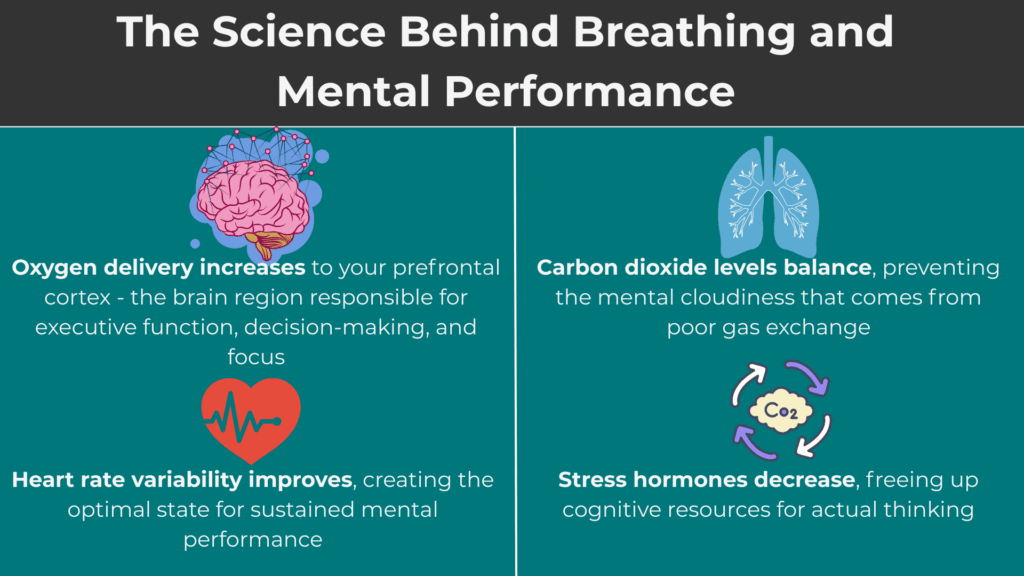
Here’s what’s really happening when you breathe properly:
- Oxygen delivery increases to your prefrontal cortex – the brain region responsible for executive function, decision-making, and focus
- Carbon dioxide levels balance, preventing the mental cloudiness that comes from poor gas exchange
- Heart rate variability improves, creating the optimal state for sustained mental performance
- Stress hormones decrease, freeing up cognitive resources for actual thinking
What Happens When Your Brain Gets More Oxygen
The research is clear: studies show that controlled breathing techniques can improve cognitive performance by up to 23%.
But here’s the thing most studies miss – the speed of the change.
We’re not talking about weeks of meditation practice. We’re talking about measurable improvements in 2-4 minutes.
That’s faster than your morning coffee kicks in.
The Focus-Killer You’re Probably Doing Right Now
Chest breathing.
Look down right now. Is your chest rising and falling with each breath? If so, you’re using maybe 30% of your lung capacity.
This is stress breathing. It’s what your body does when it thinks you’re in danger. And when your body thinks you’re stressed, your brain follows suit.
The fix is simple: Belly breathing. But most men resist it because it feels “weird” at first.
Here’s the reality: Feeling weird for a few days beats feeling foggy for years.
The 4 Breathing Techniques That Actually Move the Needle
Forget everything you’ve heard about complex breathing patterns. These four techniques are battle-tested, research-backed, and designed for men who need results, not philosophy.
The 4-7-8 Power Reset (For Instant Mental Clarity)
When to use it: Brain fog, afternoon crashes, before important meetings
How it works:
- Inhale through your nose for 4 counts
- Hold for 7 counts
- Exhale through your mouth for 8 counts
- Repeat 3-4 cycles
Why it works: The extended exhale activates your parasympathetic nervous system, while the breath retention increases oxygen saturation.
Pro tip: Do this sitting upright. Lying down makes it too relaxing and defeats the alertness purpose.
Box Breathing (The Navy SEAL Focus Method)

This is the gold standard for maintaining composure under pressure.
The pattern:
- Inhale for 4 counts
- Hold for 4 counts
- Exhale for 4 counts
- Hold empty for 4 counts
When to use it: High-pressure situations, difficult conversations, any time you need steady focus
Why SEALs use it: It works in real-world conditions. You can do it during a presentation, in traffic, or in a meeting without anyone noticing.
Wim Hof Energizer (When You Need Peak Alertness)
Warning: This is powerful. Don’t do it while driving or in water.
The method:
- Take 30 deep, rhythmic breaths (like a controlled hyperventilation)
- After the 30th exhale, hold your breath as long as comfortable
- When you need to breathe, take a deep inhale and hold for 15 seconds
- Repeat 2-3 rounds
What you’ll feel: Tingling, energy surge, laser-sharp focus
The science: shows this technique increases norepinephrine – your body’s natural focus chemical – by up to 300%.
Coherent Breathing (Your Daily Performance Foundation)
This is your baseline. Five breaths per minute. Every inhale and exhale lasts 6 seconds.
Why it matters: This matches your heart’s natural rhythm, creating optimal heart rate variability.
How to build the habit:
- Set a timer for 5-10 minutes
- Breathe in for 6, out for 6
- Focus on smooth, even breaths
- Do this same time daily (I recommend mornings)
How to Build Your Daily Breathing Protocol
Here’s the thing: Random breathing exercises won’t change your life. A system will.
Morning: Setting Your Mental Edge
Start with coherent breathing (5-10 minutes)
- Sets your nervous system for the day
- Improves decision-making capacity
- Creates baseline mental clarity
Follow with 2-3 rounds of Wim Hof if you need high energy for the day ahead.
Midday: The Focus Reset
When energy dips (usually 1-3 PM):
- 4-7-8 technique for 3-4 cycles
- Box breathing if you have a challenging afternoon ahead
- Skip caffeine for 30 minutes after breathing work – you often won’t need it
Evening: Recovery and Preparation
Coherent breathing (5-10 minutes) to shift into recovery mode.
Pro tip: This isn’t meditation. You can do coherent breathing while reading, planning tomorrow, or doing light work.
Troubleshooting: When Breathing Work Feels “Weird” or Doesn’t Work
“This feels uncomfortable.” Good. That means you’re actually changing something. Most men haven’t breathed properly in years. Discomfort is your nervous system adapting.
“I don’t have time for this.” Box breathing takes zero extra time. You can do it during your commute, in elevators, during calls. The question isn’t whether you have time – it’s whether you can afford not to.
“I’m not feeling anything.” Common mistakes:
- Breathing too shallow (use your diaphragm)
- Rushing the counts (slow down)
- Expecting meditation-style relaxation (this is performance work)
“This seems too simple.” Here’s the reality: The most powerful tools often are simple. Your brain doesn’t need complexity – it needs consistency.
Beyond Breathing: Maximizing Your Mental Performance Stack
Breathing is foundational, but it’s not everything.
Stack it with:
- Proper hydration (most brain fog is partly dehydration)
- Strategic caffeine timing (not first thing in the morning)
- Quality sleep [link to sleep optimization guide]
- Movement breaks every 90 minutes
The compound effect: When you fix your breathing, everything else works better. Your sleep improves. Your stress tolerance increases. Your physical performance goes up.
But here’s what matters most: You start feeling like yourself again. Sharp. Confident. In control.
Take Action: Your Next 7 Days
This week, pick ONE technique:
- Box breathing for steady focus
- 4-7-8 for instant clarity
- Coherent breathing for daily foundation
Do it daily. Same time, same place.
Track one thing: How you feel before and after. Rate your mental clarity on a 1-10 scale.
Here’s what most men discover: By day 3, the technique feels natural. By day 7, you can’t imagine how you functioned without it.
If this resonated with you, you’re ready to take control of your mental performance. Start today. Your future self will thank you.
Frequently Asked Questions
How long does it take to see results from breathing exercises?
Most men notice improved focus within 2-3 minutes of proper technique. Lasting improvements in baseline mental clarity typically develop after 2-3 weeks of consistent practice.
Can breathing exercises replace caffeine for focus?
While breathing techniques won’t replace caffeine entirely, they can reduce your dependence and provide sustainable energy without the crash. Many find they need 30-50% less caffeine when using these methods.
Is this just meditation in disguise?
No. While some breathing techniques overlap with meditation, these are specifically designed for performance and can be done anywhere – including during work or physical activity.
What’s the best breathing technique for beginners?
Start with box breathing (4-4-4-4 count). It’s simple, effective, and you can do it anywhere without looking like you’re doing anything unusual.
How often should I practice breathing exercises?
Daily foundation: 5-10 minutes of coherent breathing. Add power techniques (4-7-8, box breathing) as needed for specific situations requiring enhanced focus.
Disclaimer: This content is for informational purposes only and is not a substitute for professional medical advice, diagnosis, or treatment. Always seek the advice of your physician or other qualified health provider with any questions you may have regarding a medical condition.
Read More on ENERGY & PERFORMANCE


