

Table of Contents
You Know That Feeling When Your Brain Just… Stops?
It’s 2 PM. You’re sitting in a meeting that matters—the kind where decisions get made and careers get built.
But your brain feels like it’s wrapped in cotton. The CEO is asking for your input on the quarterly strategy, and all you can think about is how badly you want to close your eyes.
You look engaged on the outside. Inside, you’re running on fumes.
Sound familiar?
Here’s what most guys don’t want to admit: That mental fog isn’t just about being tired. It’s about feeling like you’re operating at 60% of your potential when everyone else seems to be firing on all cylinders.
And it’s costing you more than just productivity. It’s costing you confidence, opportunities, and that sharp edge that made you successful in the first place.
The reality? Most men over 35 are walking around with compromised mental energy and don’t even realize it. They think it’s normal. They think it’s age. They think it’s just part of the grind.
They’re wrong.
What Mental Energy Actually Is (And Why Most Men Get It Wrong)
The Science Behind Cognitive Stamina

Let’s get one thing straight: Mental energy isn’t just about feeling alert. It’s about sustained cognitive performance throughout the day.
Think of it like this: Your brain uses about 20% of your body’s total energy, even though it’s only 2% of your body weight.
Real mental energy means: • Sustained focus that doesn’t crater after lunch • Quick decision-making without second-guessing everything • Creative problem-solving when pressure hits • Emotional regulation that keeps you calm under stress • Memory recall that makes you sharp in conversations
Why “Just Push Through” Doesn’t Work Anymore
Here’s the hard truth: The “grind harder” mentality that got you to 35 won’t get you to 50.
Your brain isn’t a muscle you can just force to work harder. It’s a complex system that requires the right fuel, the right recovery, and the right optimization strategies.
When you try to push through mental fatigue: • Decision quality decreases by up to 50% • Creative thinking drops significantly • Stress hormones spike, creating a vicious cycle • Sleep quality deteriorates, making tomorrow worse • Emotional regulation suffers, affecting relationships
The Real Reasons Your Mental Energy Crashes
The Morning Energy Thief You’re Probably Ignoring
Most guys think they start the day strong. But here’s what’s really happening:
You wake up, immediately check your phone, scroll through news and emails, drink coffee on an empty stomach, and wonder why you feel scattered by 9 AM.
The truth? You just hijacked your brain’s natural energy systems before they even had a chance to come online.
Morning energy killers: • Immediate digital stimulation that floods your brain with cortisol • Caffeine without food that causes blood sugar crashes • Skipping breakfast that starves your brain of glucose • No natural light exposure that disrupts circadian rhythms • Rushing through your routine that elevates stress hormones
Want to fix this? Learn how to prevent the 9AM slump with proven morning strategies.
How Your Lifestyle Is Sabotaging Your Brain
But the morning is just the beginning. Throughout the day, you’re unknowingly draining your mental batteries:
The cognitive energy vampires: • Multitasking – Your brain burns 25% more glucose when switching between tasks • Open-loop thinking – Unfinished tasks create mental background noise • Decision overload – Every choice, no matter how small, depletes mental resources • Constant connectivity – Your brain never gets downtime to recover • Poor posture – Reduces oxygen flow to your brain by up to 30%
The Hidden Stress That’s Draining Your Focus
Here’s something most men don’t consider: Chronic low-level stress is like having a program running in the background of your computer.
You might not notice it, but it’s constantly consuming mental resources.
Hidden stress sources: • Financial pressure you don’t talk about • Relationship tension you’re trying to manage • Career uncertainty you’re keeping to yourself • Health concerns you’re ignoring • Perfectionism that makes everything harder than it needs to be
Signs Your Mental Energy System Is Failing You
Workplace Warning Signs You Can’t Ignore
Your brain will tell you when it’s struggling. The question is: Are you listening?
Professional red flags: • Afternoon crashes that make you useless after lunch • Decision paralysis on things that used to be easy • Forgetting names and details in conversations • Taking longer to complete familiar tasks • Avoiding challenging projects because they feel overwhelming • Relying heavily on caffeine just to function normally • Feeling mentally “heavy” even when tasks are simple
The Personal Life Red Flags
But it doesn’t stop at work. Mental fatigue bleeds into everything:
Personal warning signs: • Impatience with family that you feel guilty about • Avoiding social situations because they feel exhausting • Difficulty following conversations or TV shows • Procrastinating on important decisions about finances, health, relationships • Feeling “checked out” during intimate moments • Loss of interest in hobbies or activities you used to enjoy
If you’re experiencing 3 or more of these regularly, your mental energy system needs attention.
Your Complete Mental Energy Optimization Strategy
Morning Routines That Prevent the 9AM Slump
The first few hours of your day set the tone for everything that follows. Get this right, and you’re ahead of 90% of guys.
The mental energy morning protocol: • No phone for the first 30 minutes – Let your brain wake up naturally • Natural light exposure within 10 minutes of waking • Protein-rich breakfast to stabilize blood sugar • Strategic hydration with electrolytes, not just water • 5-10 minutes of intentional breathing to activate your parasympathetic nervous system
This isn’t about becoming a monk. It’s about giving your brain the conditions it needs to perform.
For a complete breakdown of morning routines that eliminate energy crashes, check out our guide to beating the 9AM slump.
Strategic Caffeine Use for Sustained Focus
Let’s be real: You’re probably going to drink caffeine. The question is whether you’re using it strategically or letting it use you.
Most guys get caffeine completely wrong: • Drinking it too early when cortisol is already high • Having too much too fast causing jitters and crashes • Using it as a crutch instead of optimizing their energy naturally • Drinking it too late and sabotaging their sleep
The smart approach: • Wait 90-120 minutes after waking before your first cup • Smaller, frequent doses rather than one massive hit • Combine with L-theanine to smooth out the jitters • Cut off 6-8 hours before bedtime • Cycle off periodically to reset your tolerance
Want the complete strategy for using caffeine to enhance, not hijack, your mental energy? Get our guide to smart caffeine use.
Breathing Techniques for Instant Brain Power
This might sound like wellness nonsense, but hear me out: Your brain needs oxygen to function, and most men are chronically under-oxygenated.
Stress, poor posture, and shallow breathing create a perfect storm of cognitive decline.
The 4-7-8 breathing technique (backed by research on autonomic nervous system regulation): • Inhale for 4 counts through your nose • Hold for 7 counts • Exhale for 8 counts through your mouth • Repeat 3-4 times when you feel mental fog setting in
Box breathing for focus: • 4 counts in, 4 counts hold, 4 counts out, 4 counts hold • Use before important meetings or challenging tasks • 2-3 minutes is enough to shift your mental state
For more advanced breathing techniques that can dramatically improve cognitive performance, explore our complete guide to breathing for brain power.
The Smart Man’s Guide to Cognitive Supplements
Here’s where things get interesting. The supplement industry wants you to believe that cognitive enhancement comes in a bottle.
Some of it’s true. Most of it’s marketing.
Supplements with solid research backing: • Omega-3 fatty acids – Essential for brain structure and function • Magnesium – Required for neurotransmitter function • B-vitamins – Critical for energy metabolism in the brain • Creatine – Not just for muscles; improves cognitive performance
Nootropics with promising but limited evidence: • Lion’s Mane mushroom – May support neurogenesis • Rhodiola rosea – Adaptogen for stress and mental fatigue • Bacopa monnieri – Traditional herb for memory and focus
The expensive stuff that’s mostly hype: • Proprietary “brain boost” blends with undisclosed amounts • Exotic compounds with single, poorly designed studies • “Limitless pill” marketing that promises unrealistic results
For a complete breakdown of what works, what doesn’t, and how to use cognitive supplements safely, read our comprehensive nootropics guide.
Building Bulletproof Mental Stamina
Daily Systems That Eliminate Mental Clutter
Mental energy isn’t just about what you put into your body. It’s about how you organize your mental environment.
Think of your brain like a computer. Too many programs running, and everything slows down.
The mental decluttering system: • Brain dumps – Get everything out of your head and onto paper • Single-tasking – One thing at a time, done well • Time blocking – Batch similar activities together • Decision templates – Pre-make routine choices • Weekly reviews – Close mental loops and plan ahead
Want the complete system for organizing your mental space like a high-performing CEO? Get our guide to focus like a CEO.
The 3 Non-Negotiables for Cognitive Performance
If you only do three things to optimize your mental energy, make it these:
1. Protect Your Sleep Architecture • 7-9 hours of quality sleep, not just time in bed • Consistent sleep schedule, even on weekends • Cool, dark room optimized for recovery • No screens 1-2 hours before bedtime
2. Move Your Body Regularly • Exercise increases BDNF – brain-derived neurotrophic factor • Even 20 minutes of moderate activity improves cognitive function • Resistance training is particularly effective for executive function • Morning movement sets the tone for mental clarity all day
3. Manage Your Stress Response • Chronic stress literally shrinks your prefrontal cortex • Meditation, even 10 minutes daily, can reverse stress-related cognitive decline • Social connection is one of the most powerful stress buffers • Purpose and meaning protect against mental fatigue
Advanced Strategies for Peak Mental Energy
Once you’ve mastered the basics, these strategies can take your cognitive performance to the next level:
Cold exposure – Cold showers or ice baths can improve focus and alertness for hours
Intermittent fasting – Strategic fasting periods can enhance mental clarity and focus
Blue light optimization – Using blue light glasses and optimizing screen time can protect circadian rhythms
Sauna use – Heat stress can improve brain health and cognitive resilience
Cognitive training – Specific brain training exercises that actually transfer to real-world performance
Your 30-Day Mental Energy Transformation Plan
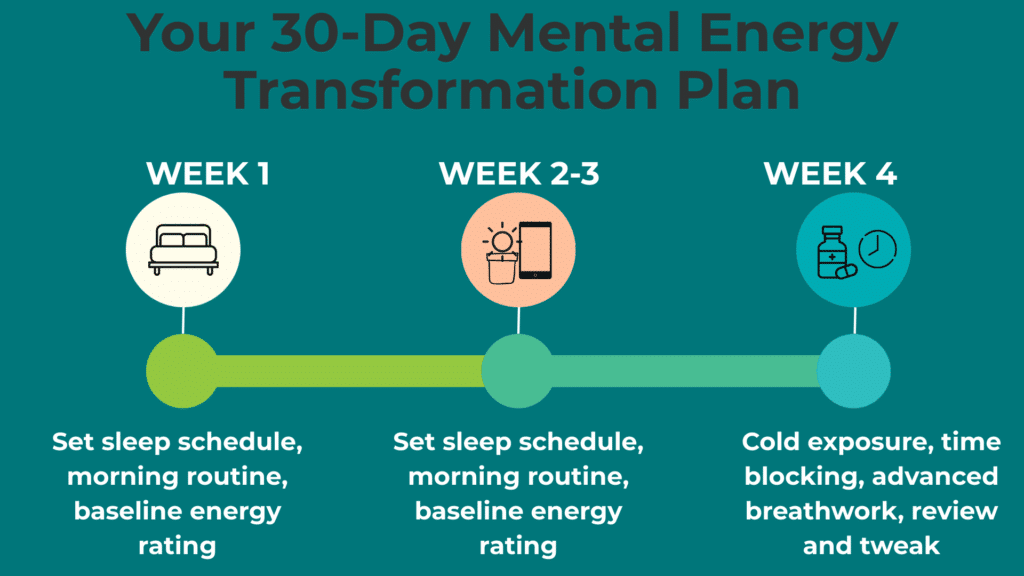
Week 1: Foundation Building
Focus: Sleep and Morning Routine • Establish consistent sleep schedule – Same bedtime and wake time every day • Create morning routine – No phone, natural light, protein breakfast • Track energy levels – Rate your mental energy 1-10 at different times of day • Baseline assessment – Notice your current patterns without judgment
Week 2-3: System Optimization
Focus: Nutrition and Stress Management • Optimize caffeine timing – Wait 90 minutes after waking, cut off 6 hours before bed • Add breathing exercises – 5 minutes of intentional breathing when you feel mental fog • Implement brain dumps – Daily practice of getting thoughts out of your head • Begin supplement trial – Start with basic vitamins and omega-3s
Week 4: Advanced Implementation
Focus: Integration and Fine-Tuning • Add cold exposure – Start with 30-second cold showers • Implement time blocking – Batch similar activities together • Advanced breathing techniques – Learn 4-7-8 and box breathing • Assess and adjust – What’s working? What needs tweaking?
The Bottom Line
Here’s what this all comes down to: Your mental energy isn’t a luxury. It’s the foundation of everything you want to accomplish.
When your brain is firing on all cylinders, you make better decisions. You solve problems faster. You lead with confidence. You show up as the man you want to be.
When it’s not? Everything becomes harder than it needs to be.
The choice is yours: • Keep accepting mental fog as “normal” • Continue relying on caffeine and willpower • Keep wondering why you feel like you’re operating at 60%
Or… • Start treating your mental energy like the strategic asset it is • Implement the systems that actually move the needle • Experience what sustained mental clarity feels like
Your next steps: • Assess your current mental energy patterns – Are you experiencing the warning signs? • Choose one area to optimize first – Morning routine, caffeine strategy, or stress management • Track your progress – Mental energy improvements are noticeable within 1-2 weeks • Build systematically – Add new strategies once the basics become automatic
Your brain has carried you this far. Isn’t it time you started taking care of it?
For more detailed strategies on optimizing your cognitive performance, explore our complete mental energy optimization series.
Frequently Asked Questions About Mental Energy for Men
How long does it take to improve mental energy naturally?
Most men notice improvements within 1-2 weeks of consistent implementation, with significant changes typically occurring within 4-6 weeks.
The timeline depends on: • Your starting point – How compromised your mental energy currently is • Which strategies you implement – Sleep and morning routine changes show results fastest • Consistency – Sporadic efforts won’t create lasting change • Individual variation – Some men respond faster than others
Are expensive brain supplements and nootropics worth the money?
Most expensive “brain boosting” supplements are overpriced marketing.
The supplements with the strongest research backing are often the most affordable: • Omega-3 fatty acids – $15-25 per month for quality fish oil • Magnesium – $10-15 per month • B-complex vitamins – $10-20 per month
Red flags for overpriced supplements: • Proprietary blends with undisclosed amounts • Claims of “instant” or “limitless” cognitive enhancement • Prices over $80 per month for basic nutrients • Heavy marketing focus on single studies
Can you really train your brain to have better focus and energy?
Yes, but with realistic expectations.
Research shows you can: • Improve attention span through focused practice • Enhance working memory with specific exercises • Build cognitive resilience through stress management • Optimize brain chemistry through lifestyle changes
What you can’t do: • Turn yourself into a superhuman overnight • Completely eliminate all mental fatigue • Expect results without consistent effort
The goal isn’t perfection. It’s optimization.
What’s the difference between mental fatigue and actual burnout?
Mental fatigue typically means: • Temporary reduction in cognitive performance • Improves with rest and recovery • Specific to certain activities or times of day • Manageable with lifestyle adjustments
Burnout means: • Chronic state of physical and emotional exhaustion • Doesn’t improve with normal rest • Affects all areas of life • Often requires professional help and significant life changes
Key difference: Mental fatigue is about energy management. Burnout is about fundamental life restructuring.
Do mental energy strategies work the same for everyone?
No. Individual variation is significant.
Factors that affect response: • Genetics – Some people are naturally more sensitive to caffeine, stress, etc. • Current health status – Underlying conditions affect cognitive function • Life circumstances – Stress levels, sleep quality, nutrition baseline • Age and hormones – Testosterone, thyroid, and other hormones impact mental energy
The key is to experiment systematically and track what works for you.
Can poor mental energy affect physical performance too?
Absolutely. The mind-body connection is real.
Poor mental energy can lead to: • Reduced motivation to exercise consistently • Poor form and technique due to lack of focus • Increased injury risk from mental fatigue • Slower recovery from physical stress • Hormonal disruption that affects both mental and physical performance
Optimizing mental energy often improves physical performance as a bonus.
Disclaimer: This content is for informational purposes only and is not a substitute for professional medical advice, diagnosis, or treatment. Always seek the advice of your physician or other qualified health provider with any questions you may have regarding a medical condition.
Read More Topics on Daily Focus & Alertness, Focus & Deep Work Optimization, Cognitive Edge


